
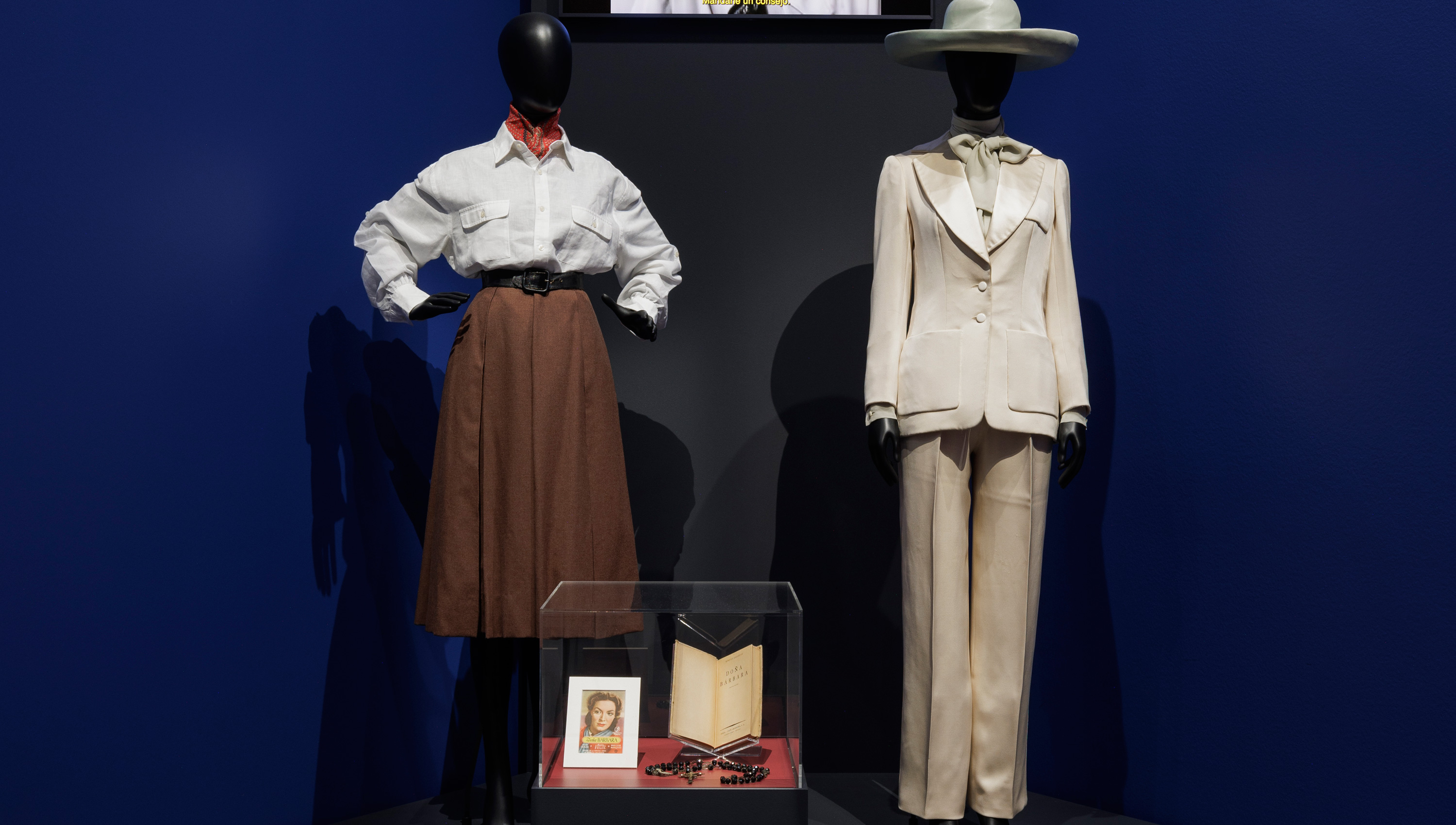
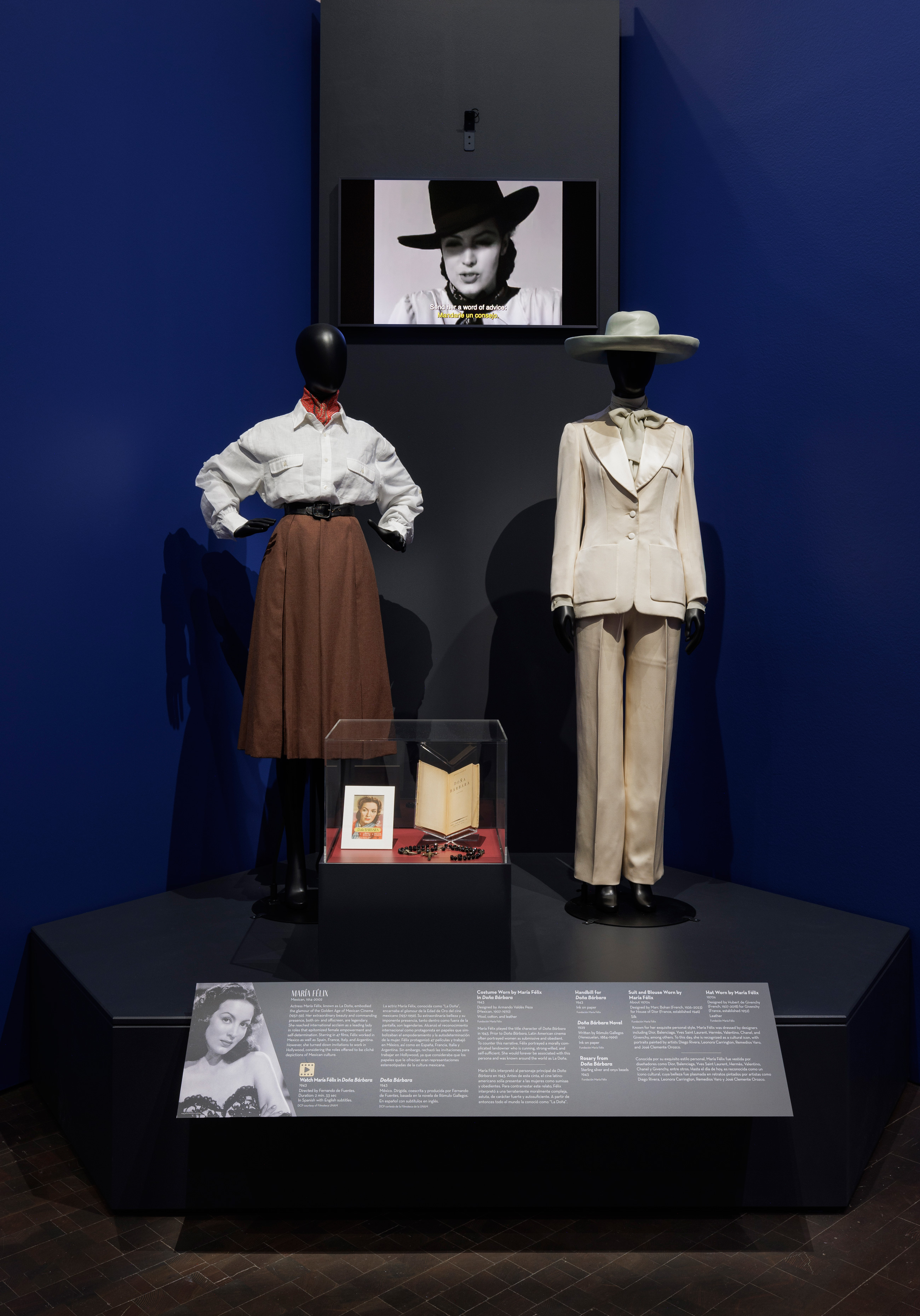
Mexican diva María Félix (1914–2002) is, once again, being featured in a stellar exhibition at the DAM. In DIVA (on view through January 31, 2027) , María Félix joins the illustrious ranks of fellow divas. This time, her objects present in the show are not any of her most spectacular jewels like those shown in Brilliant: Cartier in the 20th Century, nor a look from her glamorous outfits included in Dior: From Paris to the World. This time, the DAM has the remarkable opportunity to bring to Denver (the show’s exclusive venue in the US) the famous costume she wore when she played the leading role of La Doña in the 1943 film, Doña Bárbara. Her beauty and performance in this movie catapulted her to stardom and international fame. Her strong personality in real life transferred to the fictitious character in the film. María Félix would be associated with this role and would be known as “La Doña” for the rest of her life. It is worth mentioning that the diva never played a secondary role in any of the 47 films she starred in throughout her acting career. She filmed primarily in Mexico, Argentina, Spain, France, and Italy. She turned down offers from Hollywood as she considered the roles would present her in a stereotypical way.
María Félix made history with her Doña role, particularly in Mexico and Latin America. The character challenged the attitudes and values in a patriarchal society. She broke with the stereotype of the self-sacrificing, noble and submissive woman to portray a beautiful and shrewd woman who was self-possessed and never submitted to anyone else.
In an interview for the late-night TV show La Movida (November 27, 1991), in front of a live audience, her conversation with host Verónica Castro lasted four hours. La Doña had furniture from her house and artworks from her collection sent to decorate the set for her to feel at home during the program. In the interview, she advised women that “to lead, one must be informed, learn, and be prepared. That is why it is necessary for women to be educated…[y]ou must assert yourself, know your worth, especially in this country of machos.”
From an early age, she learned how to deal with people, usually men, who were accustomed to having a position of dominance and privilege. In the interview, she also said, “[t]he first macho I encountered was my father,” and advised women to take control of their own destiny with a powerful message: “Protest, complain, stand your ground, educate yourselves; be what you want to be, not what your man allows you to be. Love and let yourselves be loved. Do not settle for less.”
María Félix practiced what she preached. She lived a glamourous life of luxury and people celebrated her extraordinary beauty and strength of character. She inspired numerous important works of art; from paintings by artists such as Diego Rivera, Leonora Carrington, Remedios Varo, José Clemente Orozco, movies, and songs to fashion and jewelry (She designed her own pieces that Cartier later bought back to include in their collection). Félix amassed important collections of jewelry, high couture, exquisite porcelain figurines, and textiles. She wore some of her iconic jewels at the 1980 gala in Washington, DC to celebrate the arrival of the National Spanish Television Network to the United States.
Her second husband, poet and lyricist Agustín Lara, wrote a song in honor of their wedding that became endearingly linked to her wherever she appeared in public called “María Bonita.”
Her influence extended to unexpected areas as well. Alexander Berger, a French-Romanian banker and businessman, and the fourth husband of La Doña, provided connections in France and fiscal support to make the construction of the Mexico City subway (Metro) possible. Berger started negotiations with the Mexican government in 1967. Some of the planning took place in María Félix’s home and, ultimately, Berger considered his efforts as a romantic gift to her.
Among the many recognitions she received, in 1989, María Félix was awarded the Premio Ciudad de México (Mexico City Prize). In 1996 in Paris, she was named a Commander of the Ordre des Arts et des Lettres (Commander of the Order of Arts and Letters), and in 2000 she received the French Légion d'honneur (Legion of Honor), the highest civilian and military order of merit that country bestows.
Cinephiles might be curious to know that one of the films she starred in, Enamorada, recently underwent a major 4K digital restoration as part of The Film Foundation's World Cinema Project in collaboration with the UCLA Film & Television Archive, and Mexican institutions including the Filmoteca de la UNAM. It was presented at the Cannes Film Festival in 2018 by Martin Scorsese.
There are more amazing facts about this incredible DIVA to explore. I encourage you to learn about her life and contributions to the arts, fashion, and Mexican culture by visiting the María Félix Estate and María Félix Foundation.
Please plan on experiencing the power of this unique personality by visiting Doña Bárbara’s costume on view in DIVA.
