
Aboriginal and Torres Strait Islander people should be aware that this exhibition contains images, voices, and names of deceased persons.
Welcome to Country
For the Indigenous peoples of Australia, comprising both Aboriginal and Torres Strait Islander communities, art is deeply rooted in connection to Country—an all-encompassing, community-specific concept that includes land, sky, waters, living beings, Ancestral knowledge, and spirituality.
Australian Indigenous art represents the world’s oldest continuous living cultures, people who have lived and continue to live in the deserts, rainforests, mountains, and along the coasts. Over centuries, Aboriginal and Torres Strait Islander communities have maintained rich artistic histories, which connect to and reinvigorate Ancestral knowledges and form the basis of contemporary Australian Indigenous art.
Drawn exclusively from the collection of the National Gallery of Victoria in Melbourne, the works in The Stars We Do Not See reflect the diversity of Australian Indigenous artists creating across time and place. Art serves as a practice of cultural continuity, bridging past and present. It is a means for communicating traditions and asserting Indigenous identity.
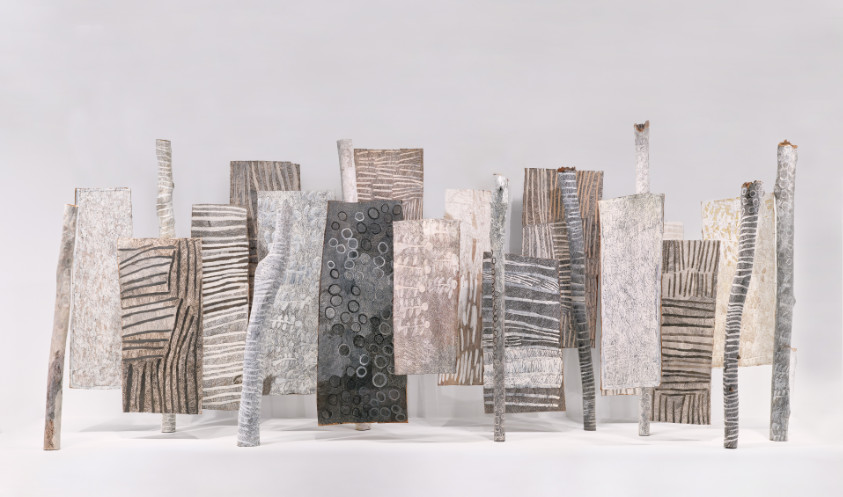
Nyapanyapa Yunupiŋu
Gumatj, about 1945–2021
Gäna (Self)
Yirrkala, Northern Territory
2009–18
Earth pigments on eucalyptus
Mary and Lou Senini bequest, 2018
My father, Munggurrawuy Yunupiŋu, taught me how to paint. He said, ‘When I am gone, you will follow behind me and paint, too. Show the people—paint and work.
This installation consists of 16 irregular bark paintings and nine ḻarrakitj (memorial poles). Titled Gäna, meaning “self,” this work is a conceptual self-portrait that reflects Nyapanyapa Yunupiŋu’s intuitive style. After creating prints for over a decade, Yunupiŋu began painting on bark in 2007, when she was in her 60s.
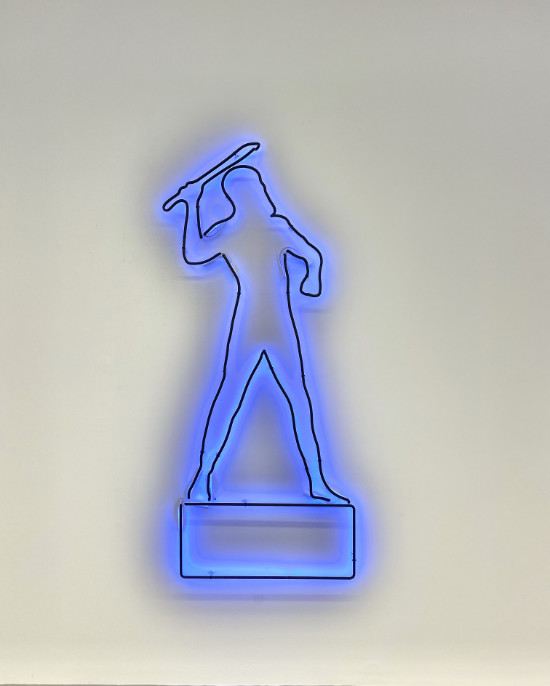
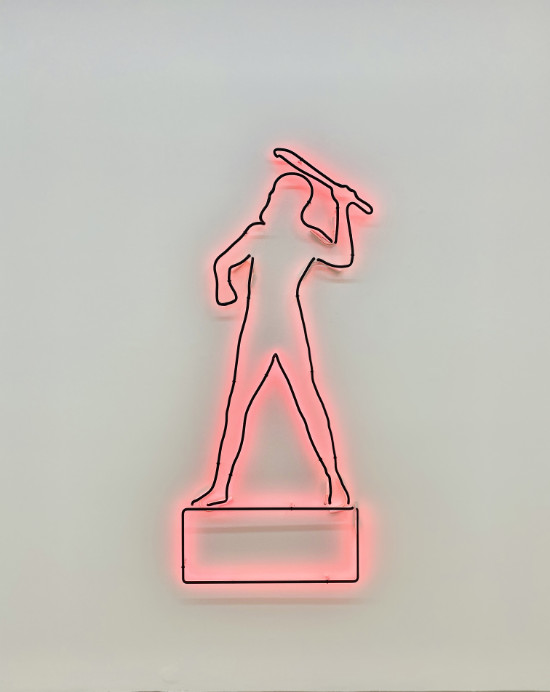
Reko Rennie
Kamilaroi, born 1974
OA Warrior I (Blue)
OA Warrior I (Pink)
Naarm (Melbourne), Victoria
2020
Neon
Purchased, Victorian Foundation for Living Australian Artists, 2020
Two neon warriors on plinths elevate and illuminate Indigenous people in Australia, who are rarely depicted in public statues. Merging historical depictions of Aboriginal men with contemporary urban culture, Reko Rennie suggests continuity between the Ancestral past and present. “OA” (Original Aboriginal), as noted in the title, is Rennie’s pseudonym and signature in the world of graffiti tagging.
Country and Dreaming
The groups that make up Indigenous Australia are unique. However, most share an understanding of the concept of Country. More than just the landscape, Country is where land, skies, waters, knowledge, bodies, and Law come together. It is understood to be closely tied to personal identity, a marker of one’s nation, and Ancestral links to a place.
Dreamings, also called Beforetimes and Everywhen, are the foundational eras when Ancestral beings shaped the world, created life, and established the Laws that govern cultural, spiritual, and social practices. Sacred knowledge of Dreamings and Country is often restricted to people within a community and must remain secret to outsiders. The works of art in this exhibition are suitable for public viewing, and none of the information described in the labels is culturally restricted.
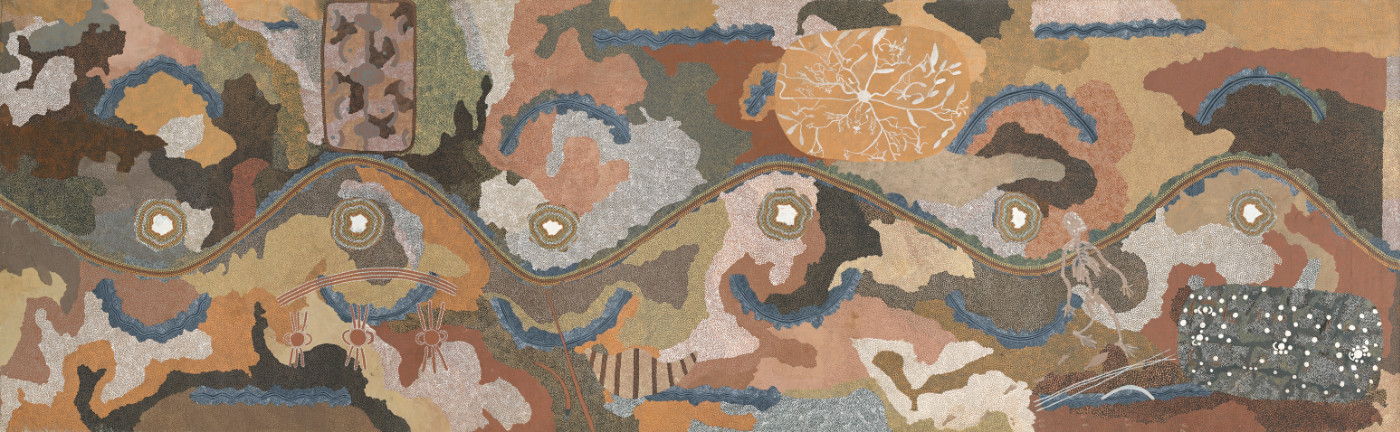
Tim Leura Tjapaltjarri
Anmatyerre, about 1929–1984
Clifford Possum Tjapaltjarri
Anmatyerre, about 1932–2002
Spirit Dreaming Through Napperby Country
Napperby, Northern Territory
1980
Synthetic polymer paint on canvas
Felton bequest, 1988
This collaborative painting chronicles the artists’ deep connection to Country while also referencing the dispossession of the Anmatyerre people by the cattle industry in the early 1900s. The vast composition includes references to earlier works by Tim Leura Tjapaltjarri, such as the depiction of yam roots—an important bush food—seen in the upper orange oval. The nearby skeletal figure might symbolize an old death spirit, perhaps reflecting Leura’s growing anguish in the final years of his life.
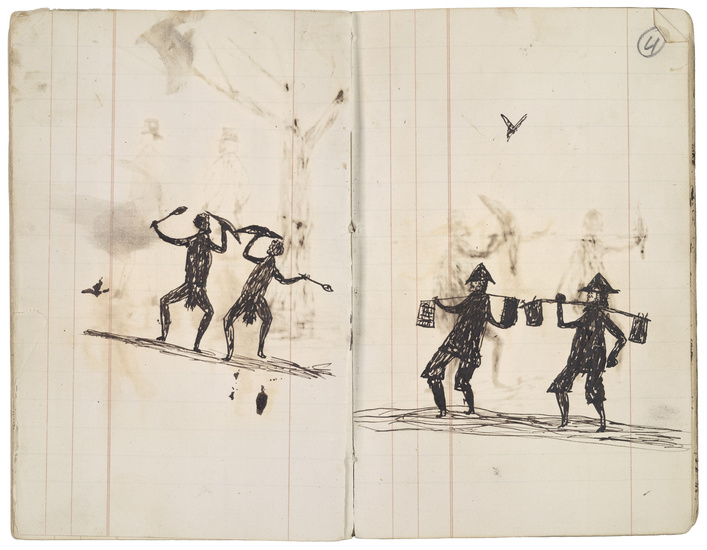
Tommy McRae
Kwatkwat, about 1836–1901
Notebook of Mr. Roderick Kilborn
Wahgunyah, Victoria
1875
Notebook with pen and ink drawings
Purchased, 2001
This notebook is the oldest work in this exhibition. Created by Kwatkwat artist Tommy McRae and commissioned by white settler Roderick Kilborn, it depicts scenes of life on the Australian frontier in the late 1800s. McRae drew Aboriginal people hunting, fishing, and performing ceremonies, preserving a vital record of cultural practices during a period of significant upheaval. This rare document contains some of the earliest-known representations of colonial activity in Victoria by an Aboriginal artist.
Star Lady
Bringing light from the past into the present and prompting dreams of the future, Gulumbu Yunupiŋu draws from the stars of the southern sky to illuminate the interconnectedness of time for her people.
Known since her passing as Star Lady, she was the first Yolŋu woman to gain international acclaim for her bark paintings. Much of her inspiration came from stories told by her father, who would describe Ancestral histories about the creation of the stars and the universe. Yunupiŋu’s fascination with the stars led her to develop a signature style characterized by dense networks of crosses unified by fields of dots. Each cross represents a star and all that is visible within the known universe, while the dots in between symbolize everything that remains unknown.
The Stars We Do Not See is named in honor of Star Lady.
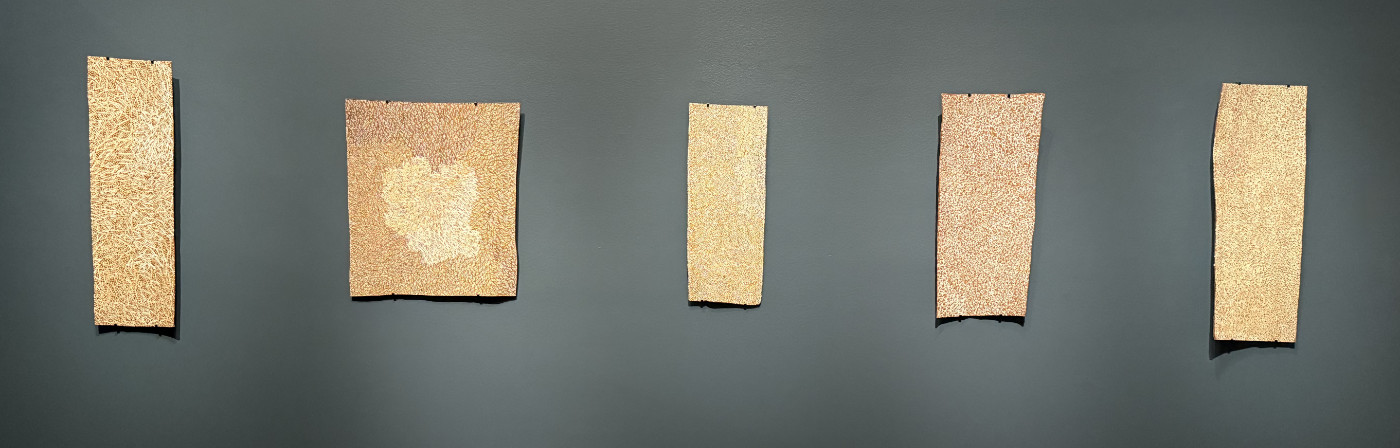
Gulumbu Yunupiŋu
Gumatj, 1945–2012
Gan’yu (Stars)
Yirrkala, Northern Territory
2010
Earth pigments on eucalyptus
Purchased NGV Foundation, 2013
Garak (The Universe)
Yirrkala, Northern Territory
2008
Earth pigments on eucalyptus
Gift of Margaret Bullen through the Australian Government’s Cultural Gifts Program, 2014
Gan’yu (Stars)
Yirrkala, Northern Territory
2011
Earth pigments on eucalyptus
Garak
Yirrkala, Northern Territory
2010
Earth pigments on eucalyptus
Garak
Yirrkala, Northern Territory
2010
Earth pigments on eucalyptus
Purchased NGV Foundation, 2013
The Stars We Do Not See: Australian Indigenous Art is organized by the National Gallery of Victoria, Melbourne and the National Gallery of Art, Washington, in association with the Denver Art Museum, the Portland Art Museum, and the Peabody Essex Museum.
Bank of America is the North America Tour Sponsor for the exhibition.

The presentation of this exhibition at the Denver Art Museum is supported by the Birnbaum Social Discourse Project, The Paul Bechtner Foundation/Marilyn Carol and Robert Weaver, the Kristin and Charles Lohmiller Exhibitions Fund, Christine and John Smith, the donors to the Annual Fund Leadership Campaign, and the residents who support the Scientific and Cultural Facilities District (SCFD).
All works are from the collection of the National Gallery of Victoria, Melbourne.


