
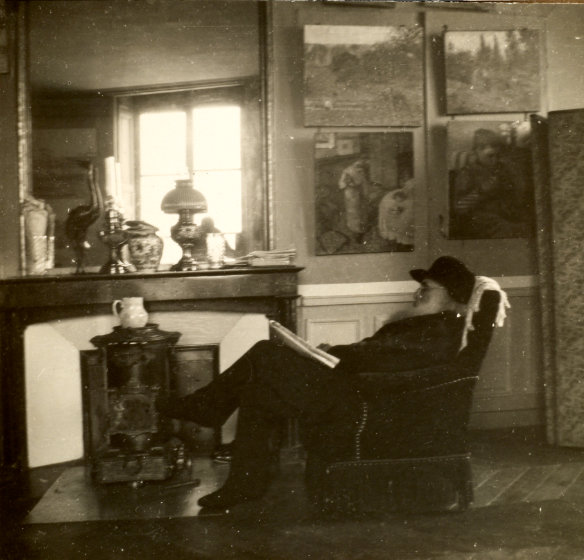
Pissarro in his Parisian apartment at 28 place Dauphine, photographed by his son Paul-Émile, about 1901. Courtesy Pissarro Family Archives
Although known as the painter of French rural life, Pissarro made more cityscapes than most of his fellow Impressionists, especially at the end of his career. In the last years of his life, Pissarro painted nearly 150 views of Paris, divided into four series. Each corresponds to a location where the artist stayed: Boulevard Montmartre, Place du Théâtre Français, Tuileries Gardens, and the Pont-Neuf. He alternated light and weather effects with different angles, using his windows’ high vantage point to capture the essence of modern urban life.
His Parisian series were a commercial success, finally offering financial stability. However, it took the French government 100 years after Pissarro’s birth, in 1930, to also recognize his success with a retrospective at the Musée de l’Orangerie. Pissarro seemed to have few regrets about his life choices, writing years earlier: “What I’ve had to suffer is inconceivable, of course, but I have lived. . . and I think that, if I had to start all over again, I wouldn’t hesitate to tread the same path.”
1895
The painter Gustave Caillebotte’s bequest to the Musée du Luxembourg includes 18 works by Pissarro—the French state only accepts seven.
1894–1906
After the Jewish captain Alfred Dreyfus is falsely accused of treason and banished from France, a rise of nationalism and antisemitism grips the country. The Dreyfus Affair divides the original impressionist group, and Pissarro’s friendship with Edgar Degas and Pierre-Auguste Renoir is tarnished by the two painters’ open antisemitism.
1903
On November 13, Pissarro dies from sepsis at the age of 73, surrounded by his family. He is buried at the Père Lachaise Cemetery in Paris.
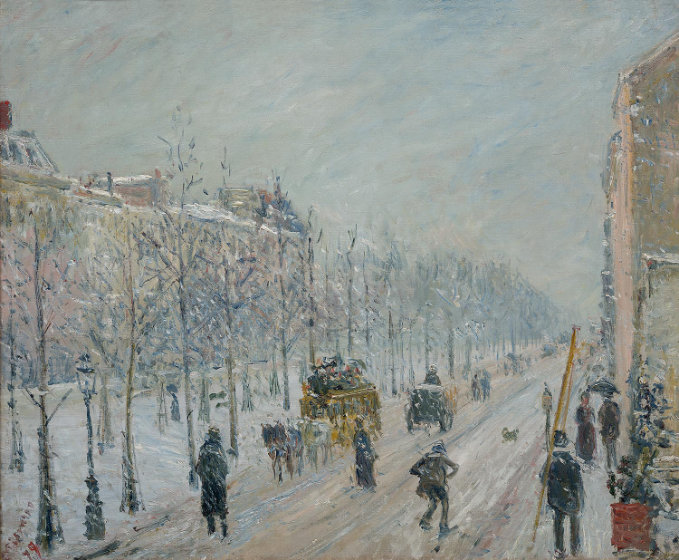
The Boulevards Extérieurs, Effect of Snow
1879
Oil paint on canvas
Musée Marmottan Monet, Paris: Gift of Eugène and Victorine Donop de Monchy, 1940, 4021
Camille Pissarro, Public domain, via Wikimedia Commons
For the Impressionists, Paris became the beacon of modernity in the late 19th century, with its widened boulevards and updated infrastructure. This painting is a testament to Pissarro’s early interest in city motifs, long before he began his later urban series. Here, he uses the architecture of the boulevard and the line of trees as structure, focusing his attention on rendering the bustling energy of the pedestrians and falling snow.
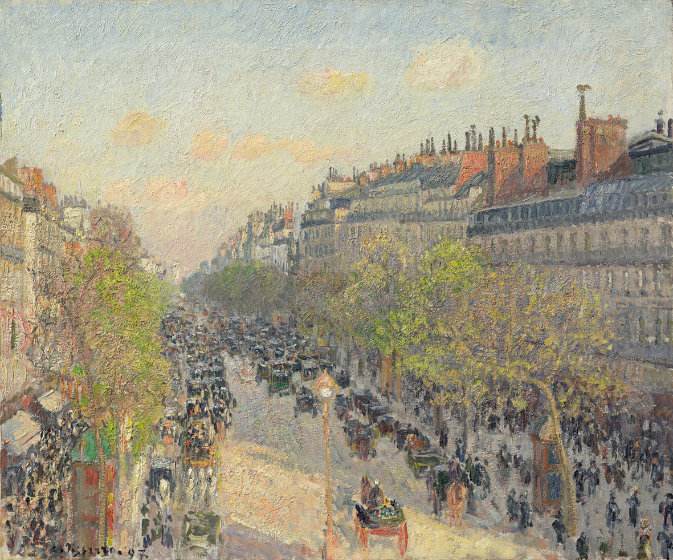
Boulevard Montmartre, Twilight
1897
Oil paint on canvas
Hasso Plattner Collection, Museum Barberini, Potsdam, MB-Pis-06
Pissarro’s time in Paris coincided with a surge in anti-Semitism in France, after Captain Dreyfus, a Jewish officer, was falsely convicted of high treason and imprisoned in 1895. Dreyfus never stopped protesting his innocence, and for twelve years French society was split over the case. The year after he made this painting, Pissarro wrote Lucien about hurrying past a mob shouting anti-Semitic chants in the streets. “Despite the grave turn of affairs, despite all of these anxieties,” he wrote, “I must work at my window.”
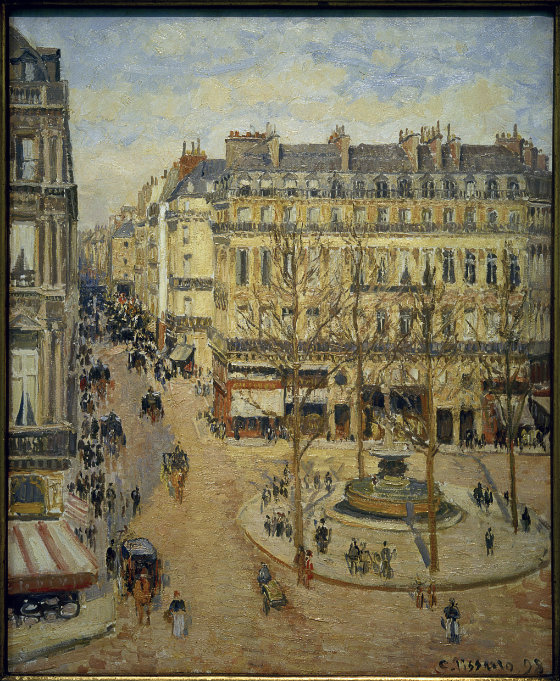
Morning Sun in the Rue Saint-Honoré, Place du Théâtre Français
1898
Oil paint on canvas
Ordrupgaard, Copenhagen, 261 WH
Image courtesy akg-images
Pissarro painted 15 variations of this view, the intersection of the round Place du Théâtre Français and the Rue Saint Honoré. Here he plays with the interaction between the circular motion, the rectilinear perspective, and the use of the vertical format. He wrote Lucien, “I’m delighted to be able to have a go at Paris streets . . . so silvery, so bright, so vibrant with life, they’re altogether different from the boulevard—they’re completely modern!”
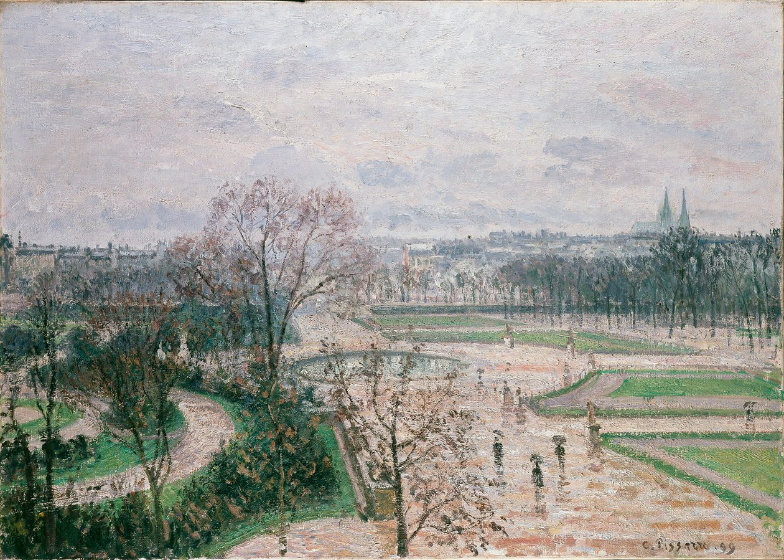
The Tuileries Gardens, Rainy Weather
1899
Oil paint on canvas
The Ashmolean Museum, University of Oxford: Bequeathed by Mrs. W. F. R. Weldon, 1936, WA1937.73
Camille Pissarro, Public domain, via Wikimedia Commons
113: The Tuileries Gardens, Rainy Weather, 1899
NARRATOR: Pissarro was thrilled to find an apartment in Paris that overlooked the Tuileries Gardens. It was a place where nature—shaped by human intervention—became part of the urban landscape.
Over the next few years, Pissarro would continue to travel between Paris, Éragny, small villages, and larger harbor towns, finding inspiration. By October of 1903, he was back in Paris, but felt unwell. His longtime doctor initially thought he had influenza, but his condition deteriorated rapidly. On November 13, surrounded by his family, Pissarro died from sepsis at the age of 73.
The funeral took place two days later in a civil ceremony where no speeches were made. There was a long procession that included his old friends: Monet, and Renoir, Durand-Ruel, Mirbeau, and others. There may not have been any speeches, but there were a great many articles written to mourn and laud the impressionist painter, the mentor, who was often called “père” or “father” by his fellow artists.
For Camille Pissarro, it was a life well lived—one dedicated to art and to his family until the very end. In an early letter, he had revealed:
CAMILLE PISSARRO: “Painting, art in general, enchants me. It is my life. What else matters? When you put all of your soul into a work, all that is noble in you, you cannot fail to find a kindred spirit who understands you… Is that not all an artist should wish for?”
NARRATOR: This is the last stop on your audio tour today – we hope you’ve enjoyed it. If you borrowed an audio device, please return it to the kiosk at the end of the exhibition. Thank you for listening.
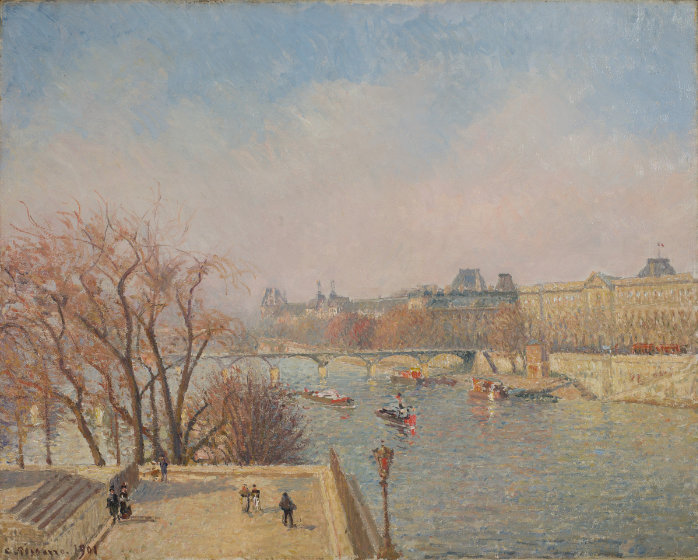
The Louvre, Morning, Sunlight (Second Series)
1901
Oil paint on canvas
Saint Louis Art Museum: Museum purchase, 225:1916
Camille Pissarro, Public domain, via Wikimedia Commons
Pissarro painted this scene from his new apartment on the Ile de la Cité, a natural island in the middle of the Seine River. From his northwest-facing window, the painter saw the Seine with the Louvre Museum in the background, depicted here with bystanders gazing at the palace-turned-museum. In The Louvre Under Snow, nearby, Pissarro transforms the same view with a wintry effect.
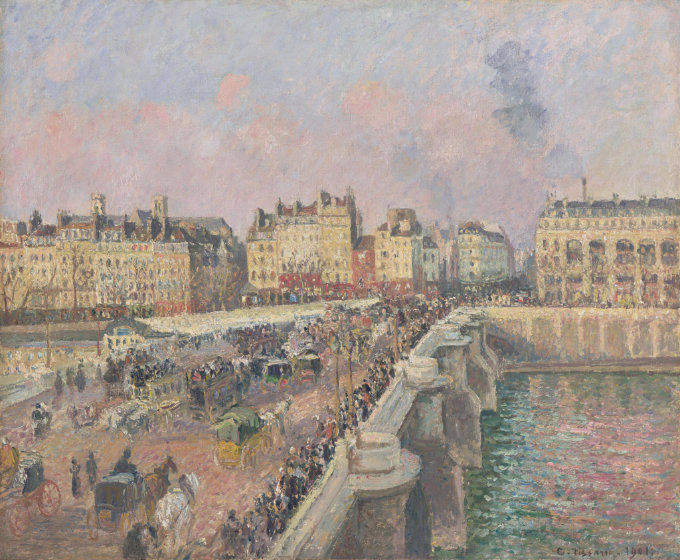
Afternoon Sunshine, Pont Neuf
1901
Oil paint on canvas
Philadelphia Museum of Art, Bequest of Charlotte Dorrance Wright, 1978, 1978-1-24
From his north-facing window in his apartment on the Ile de la Cité, Pissarro had a plunging view of the Pont-Neuf, an iconic Parisian thoroughfare over the Seine. The crowd, on foot or by carriage, hurries on to the other side of the river, where the silhouette of a large department store, the Samaritaine, is visible. In this series, Pissarro played with watery reflections and the Parisian sky, and juxtaposed old and new, reminiscent of his time in Rouen.
And so perhaps all of us come out of Pissarro . . . he really was the first impressionist.

Exhibition Guide Sections
- Introduction
- Artistic Beginnings: St. Thomas and Venezuela
- Path to Impressionism
- A Life in Letters
- Portrait of a Family
- The Impressionist Journey
- Rural Communities: Harvest and Market Scenes
- Pissarro's Fans
- At Home in Éragny
- A Garden Retreat
- Against the Grain: Politics and Neo-Impressionism
- Normandy Harbors
- Sights of Paris
- Audio Guide


The Honest Eye: Camille Pissarro's Impressionism is co-organized by the Denver Art Museum and the Museum Barberini, Potsdam.
It is presented by Jana and Fred Bartlit, Barbara Bridges, Bridget and John Grier, the Kristin and Charles Lohmiller Exhibitions Fund, and Craig Ponzio.
The exhibition is also supported by the Tom Taplin Jr. and Ted Taplin Endowment, Adolph Coors Exhibition Endowment Fund, Birnbaum Social Discourse Project, Lori and Grady Durham, Kathie and Keith Finger, Sally Cooper Murray, Ellen and Morris Susman, Lisë Gander and Andy Main, Mary Pat and Richard McCormick, Kent Thiry and Denise O'Leary, Robert Lehman Foundation, Christie's, the donors to the Annual Fund Leadership Campaign, and the residents who support the Scientific and Cultural Facilities District (SCFD). This exhibition is supported by an indemnity from the Federal Council on the Arts and the Humanities. Promotional support is provided by CBS Colorado.
