
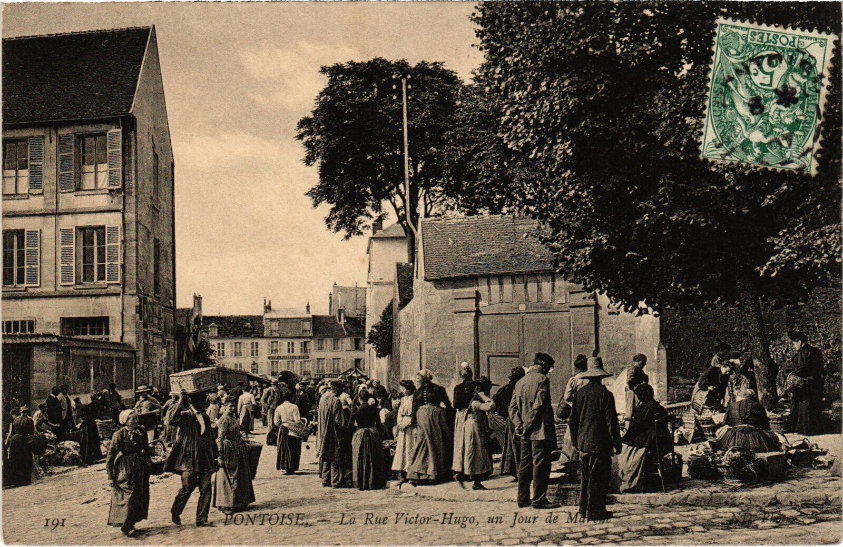
Postcard view of market day in Pontoise. Courtesy Cartorum.fr
Pissarro’s rural scenes contrast with what was traditionally associated with the peasantry: a life of difficult, demeaning, and restless labor. Instead, the artist’s representation of work is one of fulfillment and dignity, a perspective influenced by his reading of anarchist thinkers such as Élisée Reclus and Peter Kropotkin. Pissarro’s rural images of the 1880s and 1890s show the simple pleasures and even ease of life in the countryside.
Pissarro was fascinated by the economic interrelationship between work in the fields and the local markets and fairs. In contrast to the numerous images of peasants by Jean-François Millet and other French realists and naturalists, Pissarro balanced depictions of rural labor with representations of the local markets and consumption of agricultural products. Beyond the contemplative state of some of his market figures, Pissarro crowded his scenes with buyers and sellers alike, who chat, gossip, jostle, and bargain.
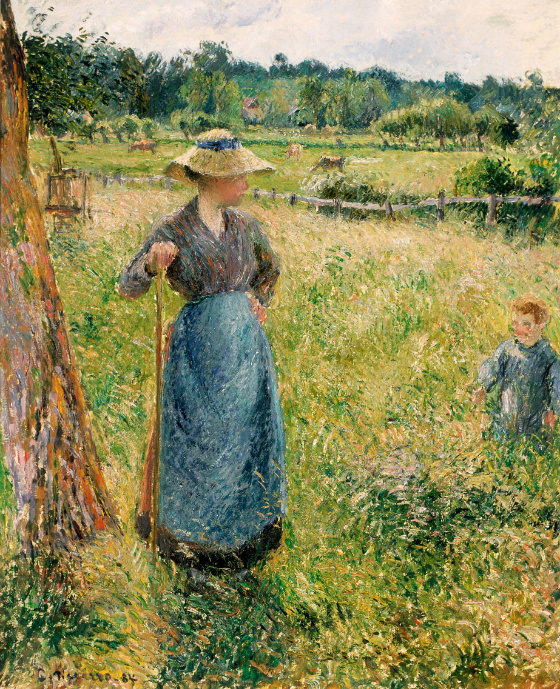
The Haymaker
1884
Oil paint on canvas
Colección Pérez Simón
Camille Pissarro, Public domain, via Wikimedia Commons
108: The Haymaker, 1884
NARRATOR: Vibrating green, yellow, and orange brushstrokes pulsate in Pissarro's The Haymaker, a subject that he would frequently depict. Here, a woman pauses from tedding, a task involving turning over hay with a pitchfork to help it dry.
This painting was made in 1884, the year of a collapse in the art market, and Pissarro’s dealer Paul Durand-Ruel was having financial difficulties. He could not purchase from the artist like before.
Pissarro anxiously wrote Monet:
CAMILLE PISSARRO: “I’m at the very end of my tether. I shall be forced to sell, for better or worse…it’s easy enough to talk of selling, but to whom? It’s driving me to distraction.”
“Do you have any news for me? I’ve received a letter from someone who said that Durand is absolutely lost …What are we to do? We should meet in Paris if we can and make a plan.”
NARRATOR: Pissarro let a few of his paintings go to another dealer, but Durand-Ruel rushed a small sum to Pissarro and asked him for patience. He advised Pissarro to put human figures aside for a time or make them incidental to his compositions. He felt the artist had a better chance of selling landscapes over pictures like The Haymaker. Pissarro resisted.
Their 32-year collaboration was bound to have its tensions, but the dealer supported Pissarro with admirable energy and determination. Later, after Pissarro died, Durand-Ruel and his sons continued to purchase paintings that came on the market, and mounted numerous solo exhibitions of his work in Paris and New York. Towards the end of his own life, Durand-Ruel poignantly revealed that he imagined paradise as having the sweetness of a Pissarro landscape.
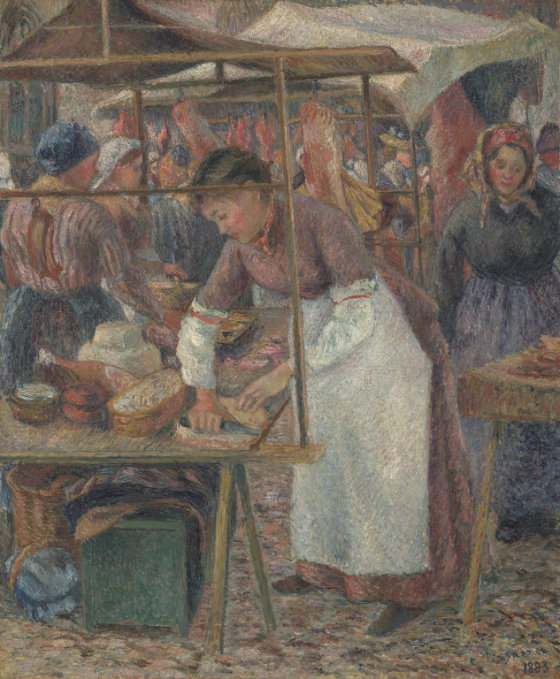
The Pork Butcher
1883
Oil paint on canvas
Tate: Bequeathed by Lucien Pissarro, the artist’s son, 1944, N05576
Here we see a close-up view of a butcher stall where the central figure is focused on her task. Pissarro’s niece, Eugénie Estruc, known as “Nini,” modeled as the butcher. Behind her, sellers and prospective buyers of all social classes crowd the compact composition. Rather than describe a specific, identifiable marketplace, Pissarro highlights female labor in action and evokes the smells and sounds of the bustling public’s space.
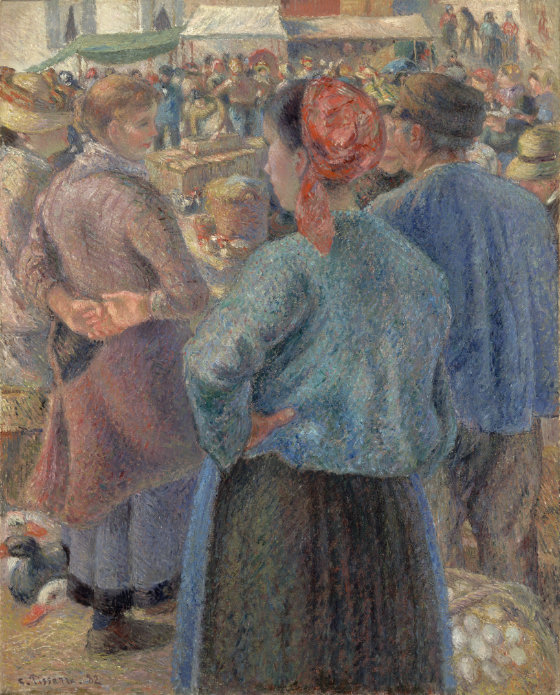
The Poultry Market at Pontoise
1882
Oil paint on canvas
Norton Simon Art Foundation, Pasadena, California: M.1984.2.P
In this striking close-up, a woman selling eggs from her basket stands with her back to the viewer. Because we don’t see her full face, the bustling energy of the market crowd just in front of her comes into focus. Pissarro emphasized the crowd rather than the place itself in this experimental composition that was included in his first solo exhibition in 1883 at Paul Durand-Ruel’s gallery.
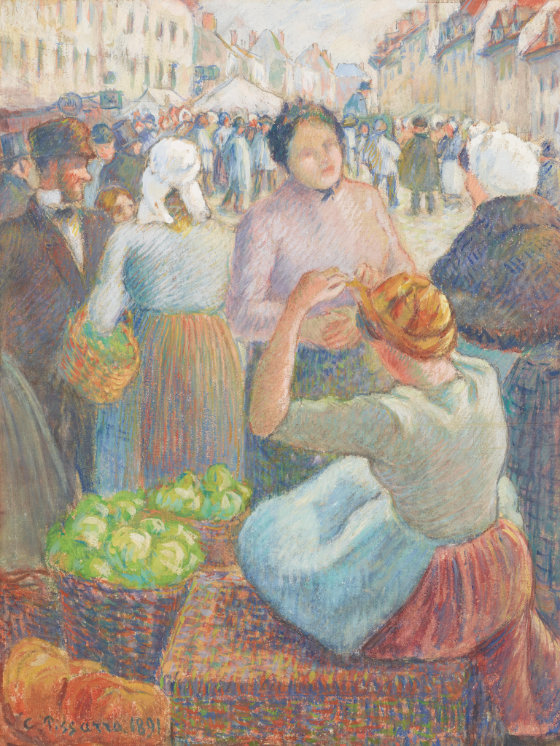
The Marketplace, Gisors
1891
Opaque watercolor with black conte crayon over traces of charcoal on fabric mounted to cardboard
Philadelphia Museum of Art: The Louis E. Stern Collection, 1963, 1963-181-55
109: The Marketplace, Gisors, 1891
NARRATOR: Pissarro had been interested in market scenes since his time in Caracas, Venezuela, and they continued to inspire him throughout his career. He was fascinated by the economic interrelationship between the fields and the town.
In these scenes, buyers and purchasers chat, gossip, jostle, bargain, and look at one another. It is a world dominated by women—the world of Julie Pissarro, rather than that of Camille’s. Julie prided herself on negotiating good prices in the markets of Pontoise and Gisors, but often had to do it on credit when money was tight.
Pissarro’ explored the subject of markets in a variety of scales and mediums, such as drawing, watercolor, gouache, tempera, pastel, etching, lithography, and oil paint. The year he made this one, he wrote to his son Lucien about the glories of watercolor:
CAMILLE PISSARRO: “Remember that watercolors help the memory, and enable you to retain the most fugitive effects—watercolors render so well the impalpable, the powerful, the delicate. And drawing is always indispensable. Divide your tones without worrying about the drying of the colors.”
NARRATOR: Here we see Pissarro experimenting with his technique—using small dashes of color to build up volumes and forms—rather than using the loose brushwork of impressionist spontaneity.
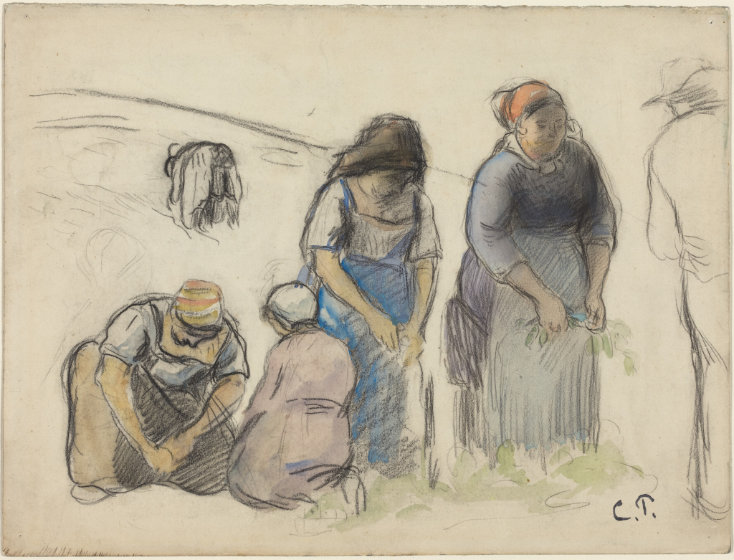
Pea Harvesters [recto]
About 1880
Charcoal and watercolor on heavy wove paper
National Gallery of Art, Washington, DC: The Armand Hammer Collection, 1991, 1991.217.21.a
Pissarro’s complex compositions of this period are based on numerous sketches. Pea Harvesters demonstrates the artist’s working method of modeling each figure individually, rendering each with a sculptural quality. He also tested a myriad of poses, different scales and placements of figures, and various colors. Pissarro’s prolific graphic production demonstrates the artist’s heightened sense of experimentation and testifies to his back and forth between working outdoors and in the studio.
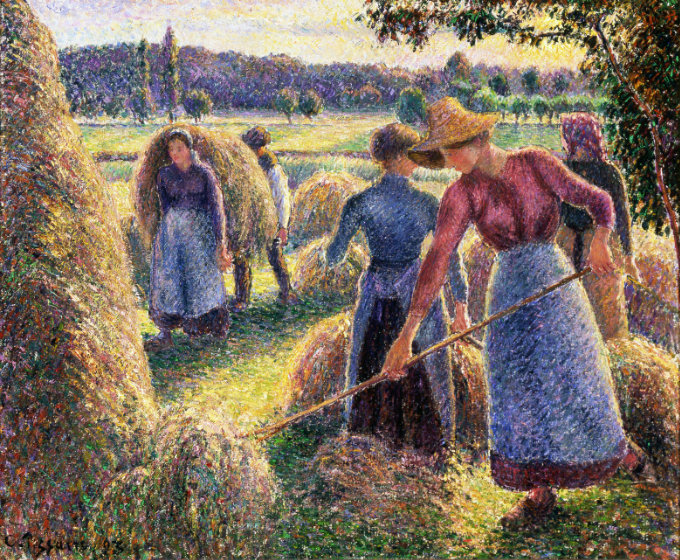
Haymakers, Evening, Éragny
1893
Oil paint on canvas
Joslyn Art Museum, Omaha, Nebraska: Museum purchase, 1946.28
Photograph by Bruce M. White, 2019.
With their heads bent and rakes in hand, young women work the fields in harmony. Rather than toil or drudgery, this rural labor resembles a dance—the way they hold their rakes sets the cadence of their work as their bodies are set in motion. Taking cues from Edgar Degas’s depictions of ballet dancers, Pissarro created a visual repertoire of rural movements in which labor and rest coexist.

Exhibition Guide Sections
- Introduction
- Artistic Beginnings: St. Thomas and Venezuela
- Path to Impressionism
- A Life in Letters
- Portrait of a Family
- The Impressionist Journey
- Rural Communities: Harvest and Market Scenes
- Pissarro's Fans
- At Home in Éragny
- A Garden Retreat
- Against the Grain: Politics and Neo-Impressionism
- Normandy Harbors
- Sights of Paris
- Audio Guide


The Honest Eye: Camille Pissarro's Impressionism is co-organized by the Denver Art Museum and the Museum Barberini, Potsdam.
It is presented by Jana and Fred Bartlit, Barbara Bridges, Bridget and John Grier, the Kristin and Charles Lohmiller Exhibitions Fund, and Craig Ponzio.
The exhibition is also supported by the Tom Taplin Jr. and Ted Taplin Endowment, Adolph Coors Exhibition Endowment Fund, Birnbaum Social Discourse Project, Lori and Grady Durham, Kathie and Keith Finger, Sally Cooper Murray, Ellen and Morris Susman, Lisë Gander and Andy Main, Mary Pat and Richard McCormick, Kent Thiry and Denise O'Leary, Robert Lehman Foundation, Christie's, the donors to the Annual Fund Leadership Campaign, and the residents who support the Scientific and Cultural Facilities District (SCFD). This exhibition is supported by an indemnity from the Federal Council on the Arts and the Humanities. Promotional support is provided by CBS Colorado.
