
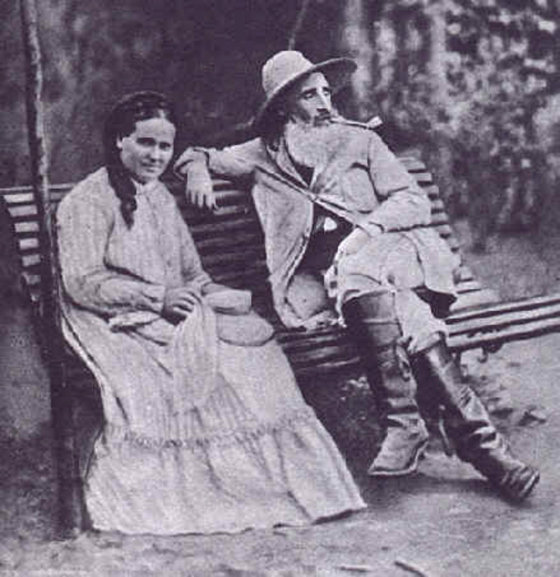
Julie and Camille Pissarro, about 1875. Historic Images / Alamy Stock Photo
Nearby, Camille Pissarro’s self-portrait from 1873 depicts a man in his home, calm and clear-eyed at the age of 43. Pissarro only painted four self-portraits during his lifetime, and the three others came in his final decade. Pissarro was a dedicated family man who never considered parenthood in conflict with his passion for art. He and his wife, Julie Pissarro (née Vellay), had eight children—six of whom lived to adulthood—making them an exceptionally large family for an artist in 1800s France.
Pissarro was determined to cultivate his artistic ideals in his children, and his letters advise them on how to draw, what to read, and how to be more ambitious. He believed that being an artist was the most beautiful vocation in the world. Even if their mother was worried about the monetary hardships that a life devoted to art would bring them, all five of Pissarro’s sons became artists in their own right.
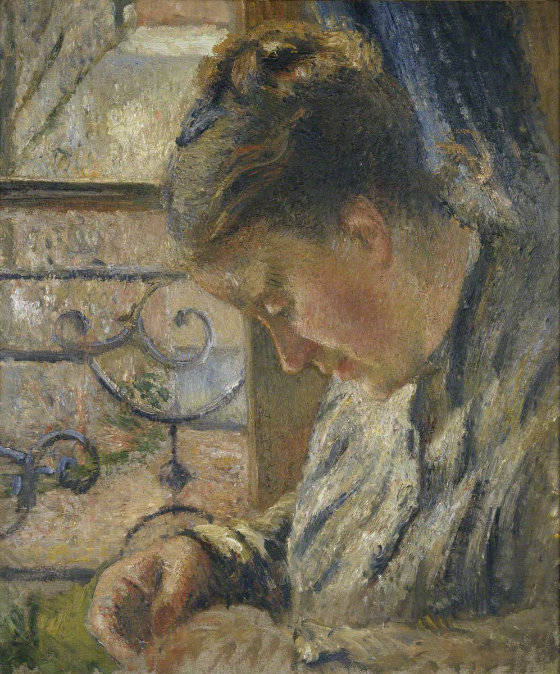
Julie Pissarro Sewing Beside a Window
About 1877
Oil paint on canvas
The Ashmolean Museum, University of Oxford: Presented by Esther Pissarro, 1951, WA1951.225.3
By Camille Pissarro - 1. Ashmolean object page2. ArtDaily.com3. Art UK, Public Domain, via Wikimedia
Julie Vellay met Camille Pissarro in 1860, when she was working as the cook’s assistant in his mother’s home. Despite disapproval from Pissarro’s family, the two became lifelong partners. Julie was the backbone of the Pissarro family as her husband struggled to sell his art until well into his 60s. However, thanks to her industriousness and frugality, the family lived reasonably comfortably. This painting is one of six that the artist dedicated to her.
106: Julie Pissarro Sewing beside a Window, c. 1877
NARRATOR: Despite her central role in Camille’s life, Julie Pissarro rarely appeared as a portrait model, though she is often found as a figure in his landscape paintings. Here she is shown fully immersed in her sewing, a testament to her dedication to her household and its tasks, which she rarely paused, even to sit for a portrait by her husband.
Although not directly involved in Camille’s artistic business, Julie visited his exhibitions, and expressed her opinion about his work. Camille respected her judgements. Even if he did not always accept her criticisms, he wanted to know what she thought. Julie was also on good terms with his many artist friends, and became the godmother of Monet’s first son, Jean.
The constant lack of money, however, led to some disagreement between Camille and Julie about how to raise their children. Concerns about their eldest son Lucien’s future was an ongoing issue. Julie believed he should get a paying job to help the family, while Camille encouraged his focus on making art. In 1884, Camille wrote to Lucien:
CAMILLE PISSARRO: “Your mother is very worried…she says that I’m pushing you toward art rather than to think about earning a living; I don’t know if I’m wrong.”
NARRATOR: In the end, six of their children would become artists—no doubt due to Camille’s dedication to their artistic education. And when Lucien’s daughter, Orovida, showed talent at five, Pissarro exclaimed:
CAMILLE PISSARRO: “The deuce! Here is still another potential artist...Her drawings are already full of feeling and elegance... It’s a beautiful and happy thing that these children have this love of art.”
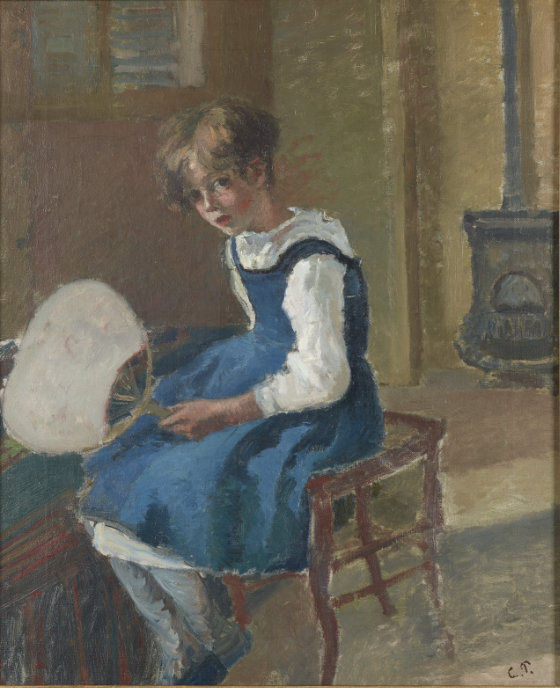
Jeanne Pissarro (Minette) Holding a Fan
About 1874
Oil paint on canvas
The Ashmolean Museum, University of Oxford: Bequeathed by Esther Pissarro, 1952, WA1952.6.2
Courtesy Ashmolean Museum
Jeanne-Rachel, nicknamed “Minette,” was a favorite model for her father, who painted her often during her short nine years. These portraits tragically document her long illness and deteriorating health before her death in 1874. Here, Minette’s hair is cut short and darkened to a reddish brown as she looks out at us with tired eyes and slumped shoulders. A portrait of her younger and healthier self nearby is in stark contrast to this painting’s sense of fragility and melancholy.
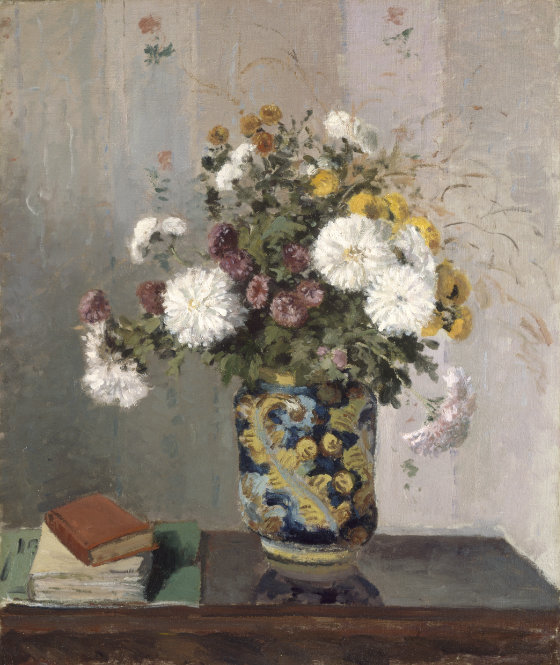
Chrysanthemums in a Chinese Vase
1873
Oil paint on canvas
National Gallery of Ireland, Dublin: Purchased 1983 (Shaw Fund), NGI.4459
During the 1870s, Pissarro engaged with the still life genre by painting floral compositions in domestic spaces. This one shows the same patterned wallpaper as Pissarro’s self-portrait from 1873, on view nearby. The delicately executed flowers on the wallpaper repeat the colors and shapes of the bouquet of white, gold, and red chrysanthemums. Like the family portraits, these still lifes celebrate the Pissarros’ domestic life in the country.

Exhibition Guide Sections
- Introduction
- Artistic Beginnings: St. Thomas and Venezuela
- Path to Impressionism
- A Life in Letters
- Portrait of a Family
- The Impressionist Journey
- Rural Communities: Harvest and Market Scenes
- Pissarro's Fans
- At Home in Éragny
- A Garden Retreat
- Against the Grain: Politics and Neo-Impressionism
- Normandy Harbors
- Sights of Paris
- Audio Guide


The Honest Eye: Camille Pissarro's Impressionism is co-organized by the Denver Art Museum and the Museum Barberini, Potsdam.
It is presented by Jana and Fred Bartlit, Barbara Bridges, Bridget and John Grier, the Kristin and Charles Lohmiller Exhibitions Fund, and Craig Ponzio.
The exhibition is also supported by the Tom Taplin Jr. and Ted Taplin Endowment, Adolph Coors Exhibition Endowment Fund, Birnbaum Social Discourse Project, Lori and Grady Durham, Kathie and Keith Finger, Sally Cooper Murray, Ellen and Morris Susman, Lisë Gander and Andy Main, Mary Pat and Richard McCormick, Kent Thiry and Denise O'Leary, Robert Lehman Foundation, Christie's, the donors to the Annual Fund Leadership Campaign, and the residents who support the Scientific and Cultural Facilities District (SCFD). This exhibition is supported by an indemnity from the Federal Council on the Arts and the Humanities. Promotional support is provided by CBS Colorado.
