
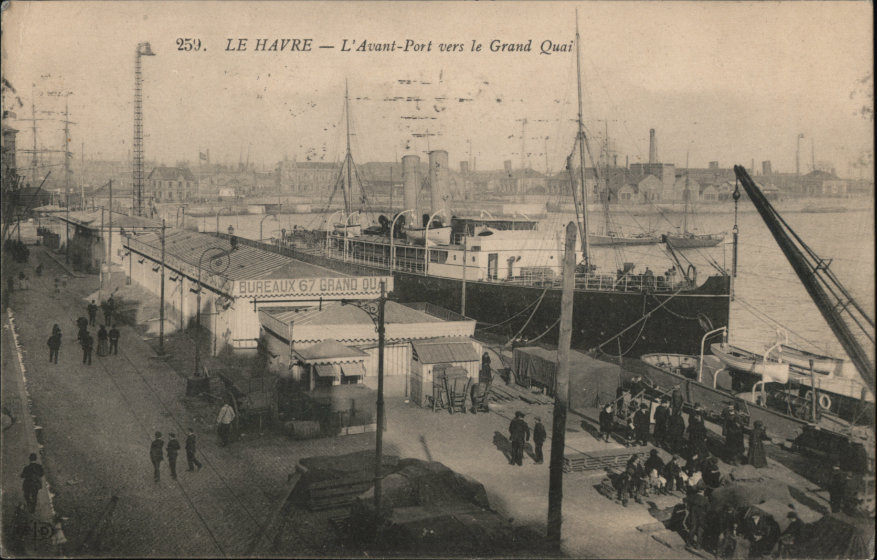
Postcard of the outer port at the Grand Quay at Le Havre. Image courtesy CardCow.com images, 874485
At the encouragement of Claude Monet, Pissarro visited the medieval French harbor city of Rouen in 1883. There, the subject matter so engaged his perpetual search for harmony in modern life that he returned to Rouen three more times. During extended visits there and to Dieppe and Le Havre over the next 20 years, he focused on the representation of those cities’ harbors and furthered his serial work. The views are full of life as they confront the old and the new and the transient and eternal elements commonly found in ports. With these paintings, the Seine River also became a central motif of his work, particularly in the later Parisian series. Today, these port views have an unexpected documentary value, as the Rouen harbor has been entirely renovated and the Dieppe and Le Havre harbors were destroyed during World War II.
1883
In the fall, Pissarro searches for new artistic motifs. Encouraged by Claude Monet, he spends two months in Rouen. Paul Durand-Ruel organizes Pissarro’s first solo exhibition in Paris, comprising 70 works.
1896–98
Pissarro completes additional trips to Rouen, producing a series of views from various hotel windows.
Summers of 1901 and 1902
Pissarro spends these two summers painting from various hotel rooms in Dieppe.
Summer 1903
Pissarro settles in Le Havre from the beginning of July to mid-September to paint his third port series. From his hotel room, he finds inspiration to complete 24 paintings. This is his last trip before his death.
I tried to represent the movement, the life, the atmosphere of the harbor thronged with smoking ships . . . I painted what I saw and felt.
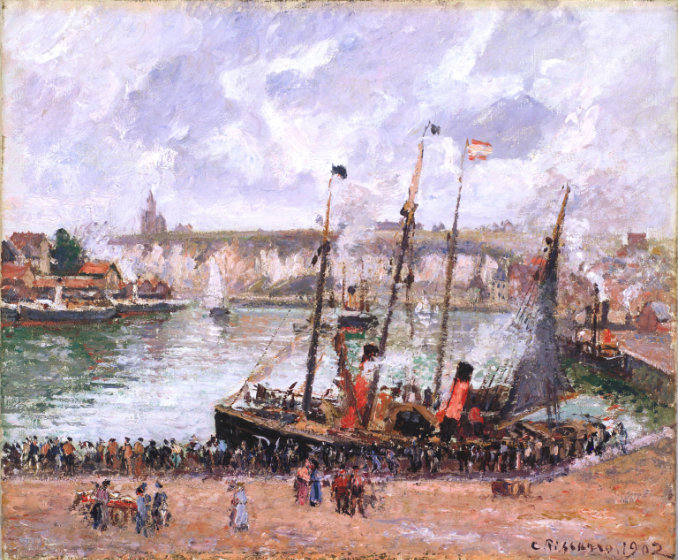
Harbor at Dieppe
1902
Oil paint on canvas
Fine Arts Museums of San Francisco: Mildred Anna Williams Collection, 1940.52
Pissarro returned to Dieppe for the second time in July 1902, writing: “Dieppe is a wonderful place for a painter who likes life, movements, colors . . . I have friends there and I know the motifs I would like to do. I’ve made up my mind to go back there this year, in spite of the crowds.” He completed 21 paintings in this series, staying at the Hotel du Commerce until the end of September.
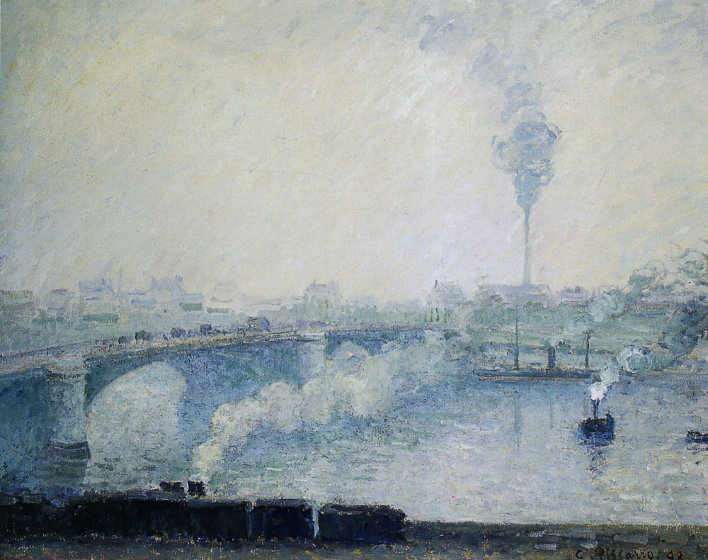
Pont Boieldieu, Rouen, Effect of Fog
1898
Oil paint on canvas
Colección Pérez Simón
112: Pont Boieldieu, Rouen, Effect of Fog, 1898
NARRATOR: By the late 1890s, Pissarro’s numerous painting trips became vitally important to him as he continued to evolve his artistic practice. Pissarro particularly like Rouen, which he knew well, having visited three times before returning in 1898 where he would paint from his hotel windows, capturing a range of weather effects. The trip was also a chance to help him through the grief of losing his son, Felix, who had died of tuberculosis the year before this painting was made. Here, the wide Seine river reflects the misty, foggy sky above; and steam from the bustling ships mingle with the billowing smoke from the factory in the background. Here’s Genevieve Westerby once more:
GENEVIEVE WESTERBY: “Pissarro did return to subjects of industrialization in the late 1890s when he visited the port at Rouen.
It's interesting to compare [the] pictures with earlier ones, which have the brighter color palette that's more indicative of early Impressionism, compared to [the] Rouen pictures that have a much darker, muted tone to them, and far more examples of factories, and steamboats, and so much smoke that you can almost feel the air pollution.”
NARRATOR: These scenes of industrial progress illustrate Pissarro’s conviction that the arts were intimately bound to their times. The world continued to change, and Pissarro was not interested in succumbing to nostalgia—he admired the energy of this new era.
He would also find this energy in Paris, where he was finally financially secure enough to keep an apartment. His family would reunite with him there after he left Rouen, and together they would spend the winter in the bustling streets of the capital.
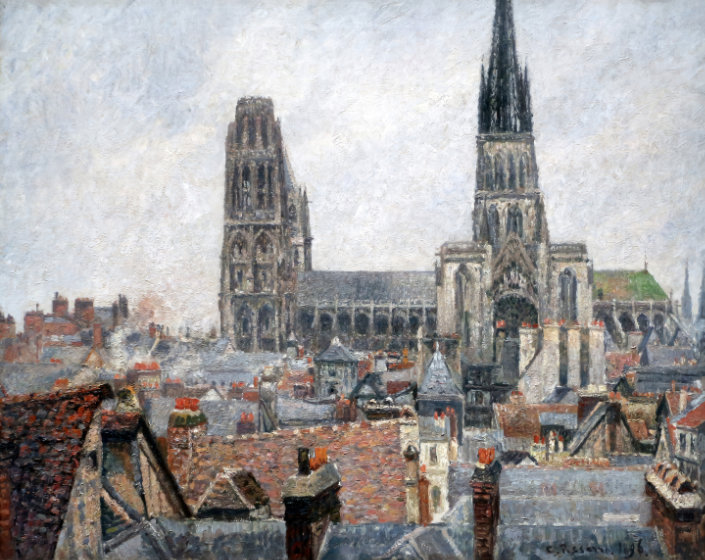
The Roofs of Old Rouen, Gray Weather
1896
Oil paint on canvas
Toledo Museum of Art: Purchased with funds from the Libbey Endowment, Gift of Edward Drummond Libbey, 1951.361
Pissarro’s serial practice greatly differed from that of fellow artist Claude Monet. While both artists focused on the effects of light and weather, Pissarro did not paint the same motif repeatedly but created variety by changing his angles. Here, warm tones perfectly capture the feel of a sunny day in a variation of Old Rouen, with its ancient rooftops and view of the cathedral.
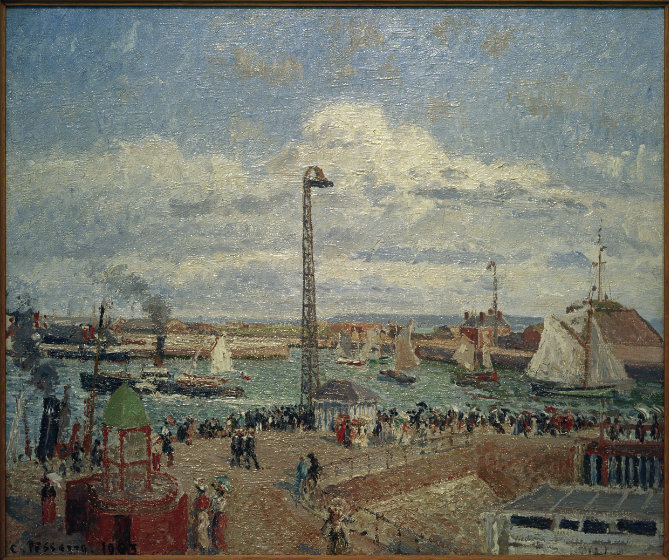
The Anse des Pilotes and the East Breakwater, Le Havre, Afternoon, Sunny Weather
1903
Oil paint on canvas
Musée d’art moderne André Malraux, Le Havre, A 494
Image courtesy AKG-Images
In the last year of his life, Pissarro painted in the port city of Le Havre, and the two paintings on this wall create a panoramic view. He was there, alone, to celebrate his 73rd birthday, and he admitted in a letter to his son Rodolphe that he was feeling his age: “It’s difficult to get set up. I’m too old to go far in search of what I want.”
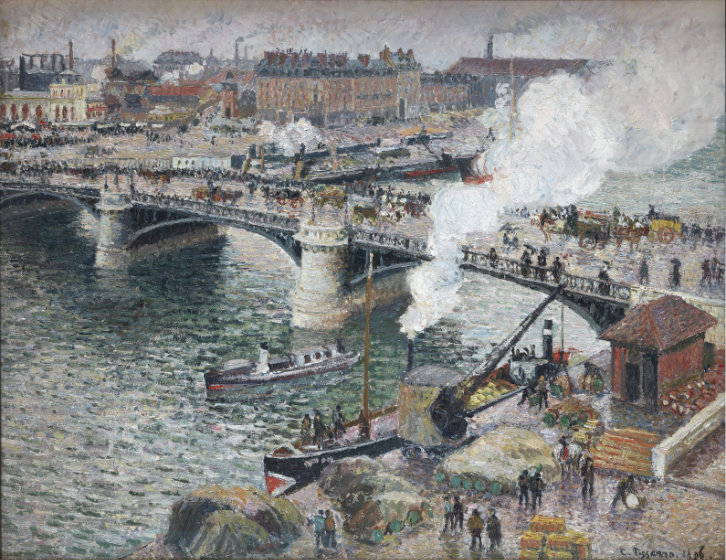
Pont Boieldieu, Rouen, Rainy Weather
1896
Oil paint on canvas
Collection Art Gallery of Ontario, Toronto: Gift of Reuben Wells Leonard Estate, 1937, 2415
Although Pissarro championed the preservation of French Gothic monuments still dotting Rouen, the first river port in France, he was fascinated by the modern bridge design of the Pont Boieldieu, which opened in 1888. He painted several variations of it during his numerous stays in Rouen. From the high vantage point of his hotel room, Pissarro played with endless variations of viewpoints, weather conditions, and the unpredictable movements of the boats and dockworkers.

Exhibition Guide Sections
- Introduction
- Artistic Beginnings: St. Thomas and Venezuela
- Path to Impressionism
- A Life in Letters
- Portrait of a Family
- The Impressionist Journey
- Rural Communities: Harvest and Market Scenes
- Pissarro's Fans
- At Home in Éragny
- A Garden Retreat
- Against the Grain: Politics and Neo-Impressionism
- Normandy Harbors
- Sights of Paris
- Audio Guide


The Honest Eye: Camille Pissarro's Impressionism is co-organized by the Denver Art Museum and the Museum Barberini, Potsdam.
It is presented by Jana and Fred Bartlit, Barbara Bridges, Bridget and John Grier, the Kristin and Charles Lohmiller Exhibitions Fund, and Craig Ponzio.
The exhibition is also supported by the Tom Taplin Jr. and Ted Taplin Endowment, Adolph Coors Exhibition Endowment Fund, Birnbaum Social Discourse Project, Lori and Grady Durham, Kathie and Keith Finger, Sally Cooper Murray, Ellen and Morris Susman, Lisë Gander and Andy Main, Mary Pat and Richard McCormick, Kent Thiry and Denise O'Leary, Robert Lehman Foundation, Christie's, the donors to the Annual Fund Leadership Campaign, and the residents who support the Scientific and Cultural Facilities District (SCFD). This exhibition is supported by an indemnity from the Federal Council on the Arts and the Humanities. Promotional support is provided by CBS Colorado.
