
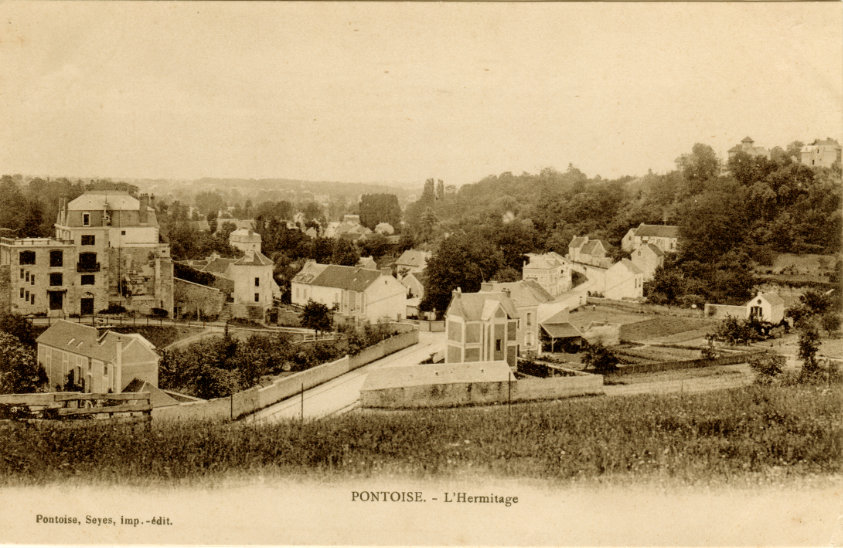
Postcard of The Hermitage in Pontoise. Courtesy Société Paul Cézanne
Contrary to its widespread popularity today, the art of the Impressionists was originally viewed as radical and was intensely criticized. In 1873, Pissarro, alongside Claude Monet, Edgar Degas, and others, founded a group that sought to break away from academic conventions and promote a new way of painting. They took inspiration from contemporary life and everyday landscapes, often working outdoors. The following year, they organized their first exhibition, to the displeasure of the critics.
Pissarro was the only artist to renounce the official Paris Salon from that point on and to participate in all eight impressionist exhibitions. Called the “father” of the Impressionists, and even “first among the Impressionists,” Pissarro has long been revered for his catalyzing role. As the eldest in the group—he was 44 in 1874—he played a leading role in organizing exhibitions and mentoring younger artists.
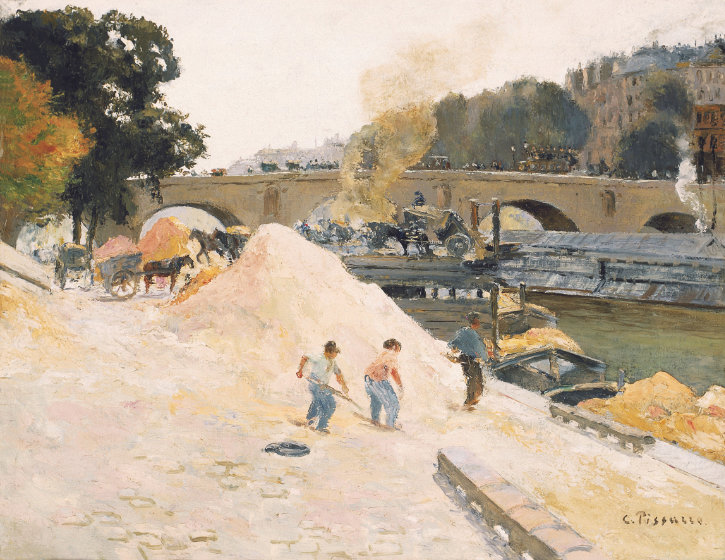
The Pont-Marie Viewed from the Quai d’Anjou, Paris
About 1875
Oil paint on canvas
Colección Pérez Simón
Camille Pissarro, Public domain, via Wikimedia Commons
In 1863, the French poet Charles Baudelaire published an essay encouraging the depiction of modern life, leading the Impressionists to the beacon of modernity: Paris. In the distance, heavy traffic crosses the Pont-Marie to reach the other side of the Seine River, while in the foreground, workers toil on the Quai d’Anjou. Throughout his life, Pissarro maintained an interest in industrial progress and change along waterways.
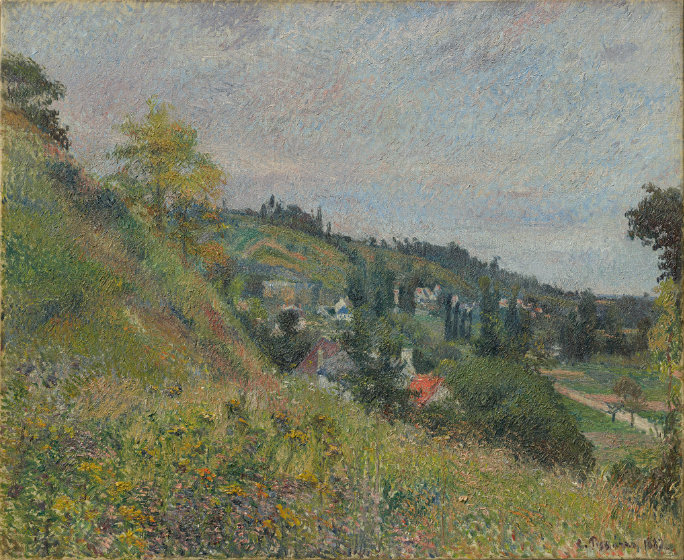
The Hills at Le Chou, Pontoise
1882
Oil paint on canvas
Hasso Plattner Collection, Museum Barberini, Potsdam, MB-Pis-01
107: The Hills at Le Chou, Pontoise, 1882
NARRATOR: Here, Pissarro’s minute brushstrokes create a pulsating texture that evokes the lush variety of flowers and grasses of an overgrown meadow. This would be his last summer in Pontoise before moving the family once more.
Although Pissarro remained in the countryside, his deep friendships forged early on in the Paris studios and museums—such as with Claude Monet, Paul Cezanne, and Edgar Degas—endured, and many came to visit him. Pissarro drew in so many artists that there was talk of a Pontoise school. They had all rejected academic art, and preferred working side by side, critiquing each other’s work as they experimented with color and technique. Pissarro, the eldest of the group, took on a mentorship role. Mary Cassatt would later say he was so effective that he could “teach the stones to paint properly.”
But Pissarro’s constant struggle to sell would let bouts of self-doubt creep in. The year after he painted this Pontoise scene, he wrote his son Lucien:
CAMILLE PISSARRO: “Sometimes I am horribly afraid to turn around canvases that I have piled against the wall; I am constantly afraid of finding monsters where I believed there were precious gems!...However, at times I come across works of mine that are soundly done and really in my style, and at such moments I find great solace.”
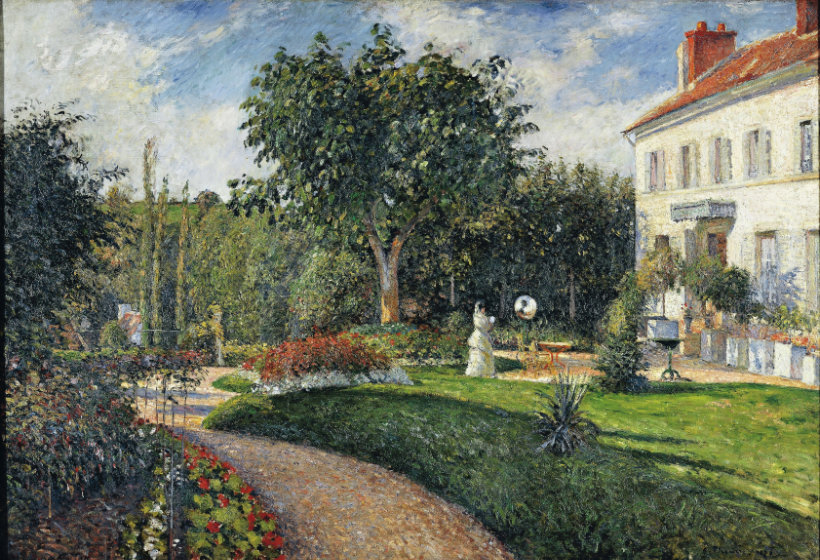
The Garden of Les Mathurins at Pontoise
1876
Oil paint on canvas
The Nelson-Atkins Museum of Art, Kansas City, Missouri: Purchase, William Rockhill Nelson Trust, 60-38
Image courtesy akg-images / De Agostini Picture Lib. / J. E. Bulloz
Exhibited at the third impressionist exhibition in April 1877, this unusually large painting’s emphasis on bourgeois leisure seems to be an anomaly among Pissarro’s broader depictions of the rural world and everyday labor. However, the owner of this prosperous estate was Maria Deraismes (1828–1894), a feminist and an activist with whom Pissarro shared political views and who might be depicted here, wearing a white dress and facing a mirrored garden globe while reading a letter or pamphlet.
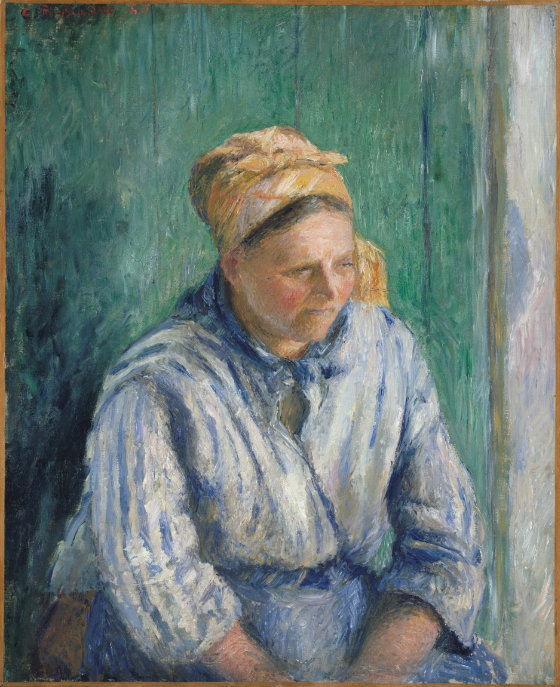
Washerwoman, Study
1880
Oil paint on canvas
The Metropolitan Museum of Art, New York: Gift of Mr. and Mrs. Nate B. Spingold, 1956, 56.184.1
Camille Pissarro, Public domain, via Wikimedia Commons/ The Metropolitan Museum of Art
Marie Adeline Larchevêque, Pissarro’s 56-year-old neighbor in Pontoise, also called “Mother Larchevêque,” sits quietly in a contained and meditative pose, showing the wisdom of her age. The painting challenges the expectations of an audience used to portraits of well-to-do sitters—not workers. Pissarro displayed the painting under the generic title Laveuse, étude (Washerwoman, Study) at the 1882 impressionist exhibition. By not identifying the sitter, he turned the work into the depiction of a type.
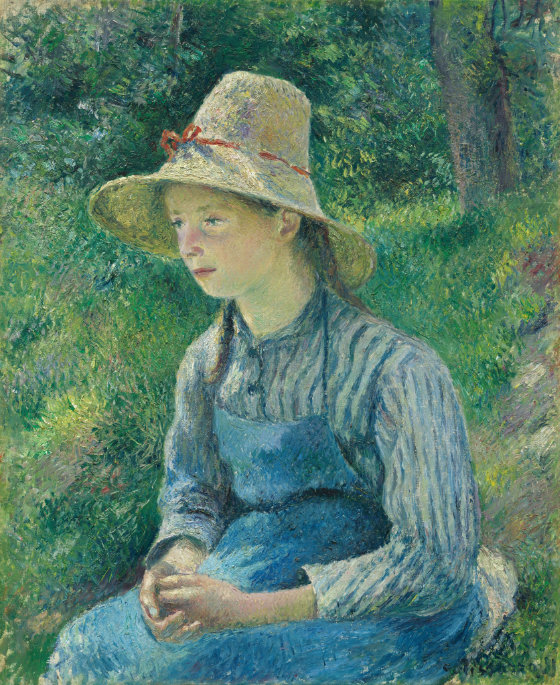
Peasant Girl with a Straw Hat
1881
Oil paint on canvas
National Gallery of Art, Washington, DC: Ailsa Mellon Bruce Collection, 1970.17.52
Pissarro increasingly emphasized figures in his paintings starting in 1880, until they became the main subject for an extended period of time. The three paintings on this wall were among the 14 figure paintings Pissarro displayed at the 1882 impressionist exhibition. At this time, it was uncommon to dedicate portraits to ordinary people—Pissarro’s portraits of female workers seated, leaning, or lying on the grass were radical in their celebration of French rural life.

Exhibition Guide Sections
- Introduction
- Artistic Beginnings: St. Thomas and Venezuela
- Path to Impressionism
- A Life in Letters
- Portrait of a Family
- The Impressionist Journey
- Rural Communities: Harvest and Market Scenes
- Pissarro's Fans
- At Home in Éragny
- A Garden Retreat
- Against the Grain: Politics and Neo-Impressionism
- Normandy Harbors
- Sights of Paris
- Audio Guide


The Honest Eye: Camille Pissarro's Impressionism is co-organized by the Denver Art Museum and the Museum Barberini, Potsdam.
It is presented by Jana and Fred Bartlit, Barbara Bridges, Bridget and John Grier, the Kristin and Charles Lohmiller Exhibitions Fund, and Craig Ponzio.
The exhibition is also supported by the Tom Taplin Jr. and Ted Taplin Endowment, Adolph Coors Exhibition Endowment Fund, Birnbaum Social Discourse Project, Lori and Grady Durham, Kathie and Keith Finger, Sally Cooper Murray, Ellen and Morris Susman, Lisë Gander and Andy Main, Mary Pat and Richard McCormick, Kent Thiry and Denise O'Leary, Robert Lehman Foundation, Christie's, the donors to the Annual Fund Leadership Campaign, and the residents who support the Scientific and Cultural Facilities District (SCFD). This exhibition is supported by an indemnity from the Federal Council on the Arts and the Humanities. Promotional support is provided by CBS Colorado.
