
After 10 years in Pontoise, the Pissarros struggled to afford rent. After a long search for the right location—not only in price but with appealing motifs to paint—Pissarro settled the family in Éragny-sur-Epte, a small village in Normandy, in 1884. It was situated only a few miles away from Giverny, where fellow Impressionist Claude Monet had moved the previous year.
At Éragny, Pissarro painted in his garden and fields and from the large windows of his barn-turned-studio. His paintings reveal an interest in diversifying angles of the same view, integrating rural figures and features into the landscape, and finding, above all, harmony. Although he often felt isolated in Éragny, his work and his family kept him largely content. There, he also looked after the children’s artistic education—encouraging them to hone their drawing skills in the hope that they would “begin to look at nature more attentively and passionately.”
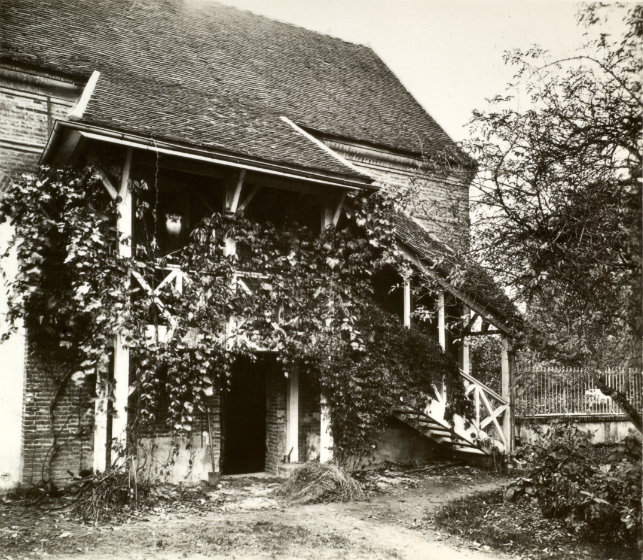
Camille Pissarro on the Staircase at the Top of His Studio in Éragny-sur-Epte Courtesy Pissarro Family Archives
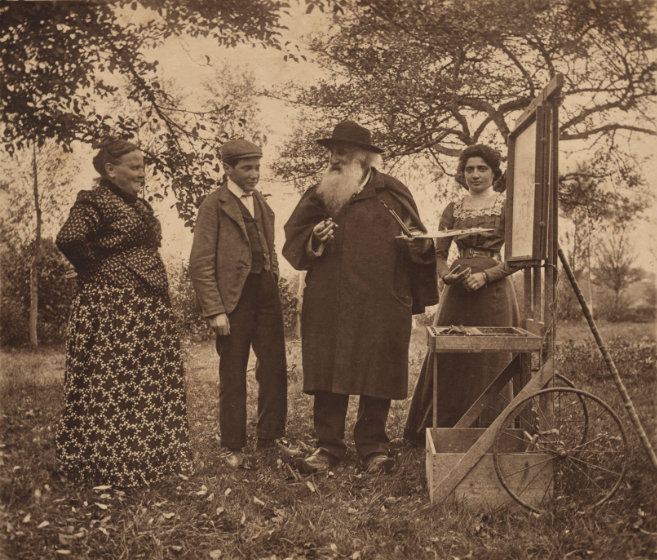
Camille Pissarro with Julie, Paul-Émile, and Jeanne in the orchard at Éragny, late 1890s. Courtesy Pissarro Family Archives
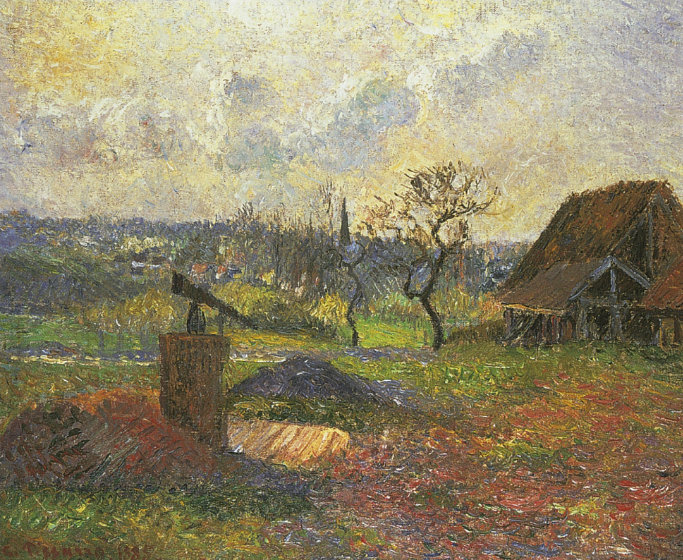
The Delafolie Brickyard, Éragny
1885
Oil paint on canvas
The Ashmolean Museum, University of Oxford: Bequeathed by Frank Hindley Smith, 1939, WA1940.1.12
Camille Pissarro, Public domain, via Wikimedia Commons
Here, Pissarro depicts his neighbor’s property and his profession: Delafolie was a brick merchant whose house stood at the entrance of the village. The men were on excellent terms, and Pissarro mentioned Delafolie and his son in his letters. Pissarro often took advantage of their frequent trips to Paris and would ask the Delafolies to drop off paintings to his dealer, Paul Durand-Ruel. Anecdotally, Delafolie was also a homemade cider provider for Pissarro and Monet.
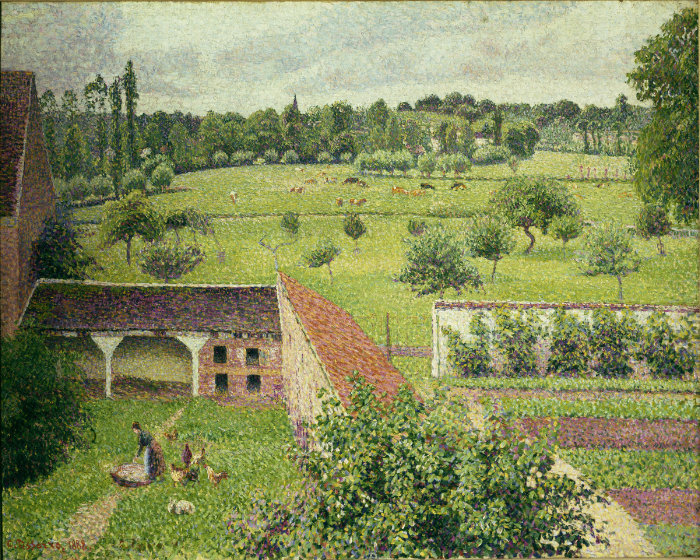
View from My Window in Cloudy Weather
1886–88
Oil paint on canvas
The Ashmolean Museum, University of Oxford: Presented by Mrs. Lucien Pissarro, 1950, WA1950.185
Image courtesy akg-images
This painting and the one next to it reflect Pissarro’s exploration of different brushwork techniques along with an elevated view of the artist’s barn in Éragny before and after its transformation into a studio. Here, the vegetable garden, henhouse, and Pissarro’s barn are all in view, along with the rolling meadows that meet the Epte River at the back of the property. This vantage point was likely chosen due to a chronic eye infection that at times forced Pissarro to paint indoors.
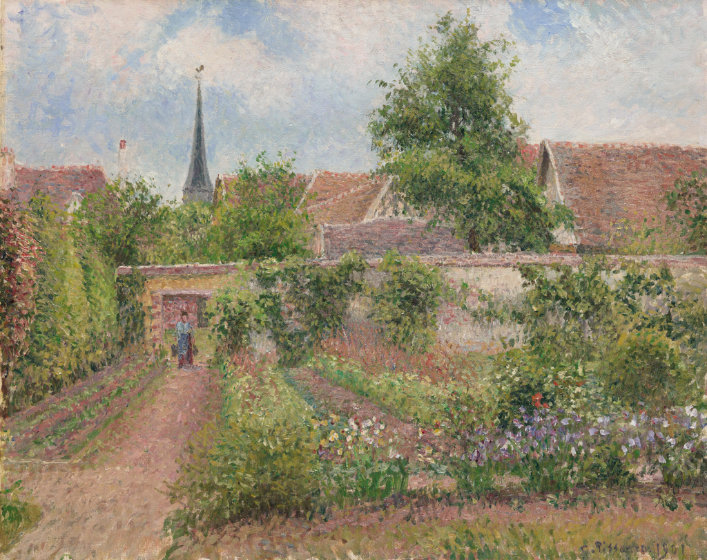
Vegetable Garden, Overcast Morning, Éragny
1901
Oil paint on canvas
Philadelphia Museum of Art: Bequest of Charlotte Dorrance Wright, 1978, 1978-1-26
110: Vegetable Garden, Overcast Morning, Éragny, 1901
NARRATOR: In Éragny, Pissarro painted numerous views of the garden from differing vantage points and at varying times of the day and year. Pissarro intentionally chose unpretentious subjects. Often the compositions show simple, less-than-picturesque motifs such as scenes with the garden wall in the background, shrubbery and garden beds, and the path between the chicken coop and the house.
Here, a solitary female figure carrying pails—presumably Julie Pissarro—appears down the path next to the carefully tended gardens. The active, formative role of the human being distinguishes Pissarro’s garden scenes from the motifs of other Impressionists, who generally showed the landscape as the setting for middle-class leisure activities.
Although plein-air practice dominated Pissarro’s early Impressionist years, Pissarro sometimes worked indoors. Circumstances often forced him to. Pissarro struggled with chronic eye infections for some time, and they worsened around 1889, making it difficult for him to paint outside. Months after he painted this scene, he wrote to Lucien:
CAMILLE PISSARRO: “My eye bothers me constantly. The slight change of weather induces an inflammation…”
NARRATOR: As the condition worsened, he received differing advice, which left him confused and anxious. He championed homeopathic medicine, but his eye problems led him to see an endless parade of doctors. Pissarro, true to form, remained upbeat, writing after an operation:
CAMILLE PISSARRO: “I will probably have fewer abscesses now, which will mean I can work a little. Besides, I’m getting used to the idea of having only one eye to work. It will still be better than nothing!”
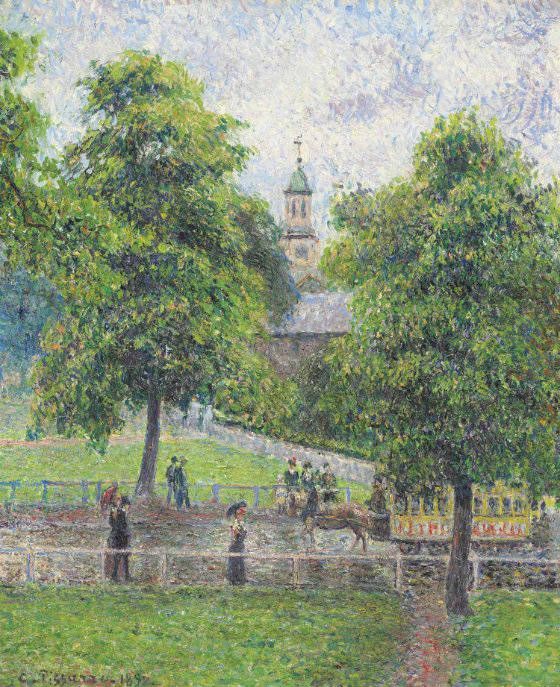
Saint Anne’s Church in Kew, London
1892
Oil paint on canvas
Collection of Prof. Mark Kaufman, Monaco
Camille Pissarro, Public domain, via Wikimedia Commons
In May 1892, Pissarro traveled from Éragny to London to support his eldest son, Lucien, who had settled there and fallen in love with Esther Bensusan. Bensusan’s father, though, disapproved of Lucien’s artist profession and lack of religious conviction. Despite the frustrating parallels to his own past, Pissarro was thrilled with the change of scenery and wrote, “I’m at Kew, taking advantage of this exceptional summer to throw myself headlong into my plein air studies in this stunning park.”
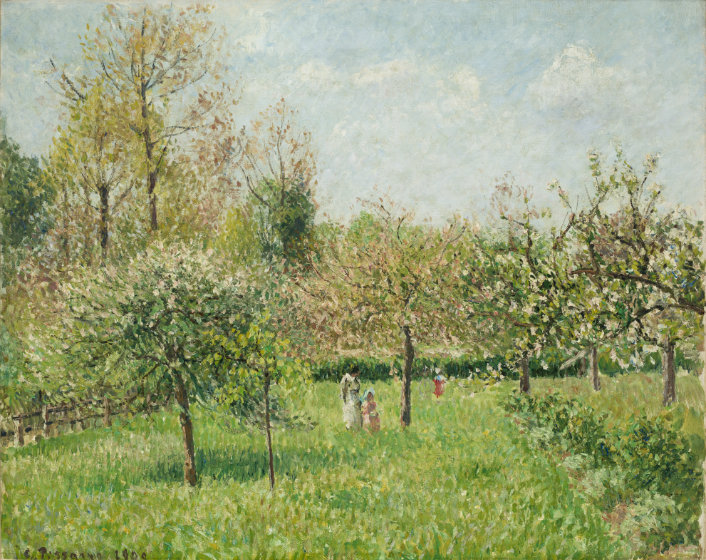
Spring at Éragny
1900
Oil paint on canvas
Denver Art Museum: Frederic C. Hamilton Collection, bequeathed to the Denver Art Museum, 30.2017
Thanks to eye surgery in 1891, Pissarro was able to paint outdoors again with the help of a rolling easel. Here, the figures—likely the artist’s family—enjoy themselves in nature and harmonize with the shimmering, blossoming spring trees. In a letter to Claude Monet, relieved at the reprieve in his health, Pissarro wrote: “It seemed so good for me to work outside.”
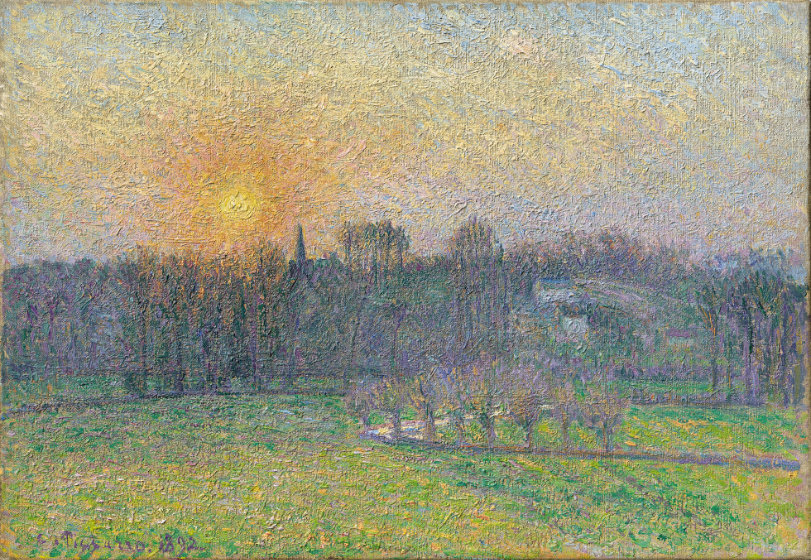
View of Bazincourt, Sunset
1892
Oil paint on canvas
Hasso Plattner Collection, Museum Barberini, Potsdam, MB-Pis-04
Across the Epte River at the back of Pissarro’s property, lay the picturesque village of Bazincourt, which the artist painted at least 40 times. Changing seasons, weather conditions, and light provided endless inspiration and set the stage for his explorations with color and technique. Always seeking new harmonies, Pissarro used dots and stipples of blazing hues to indicate movement.

Exhibition Guide Sections
- Introduction
- Artistic Beginnings: St. Thomas and Venezuela
- Path to Impressionism
- A Life in Letters
- Portrait of a Family
- The Impressionist Journey
- Rural Communities: Harvest and Market Scenes
- Pissarro's Fans
- At Home in Éragny
- A Garden Retreat
- Against the Grain: Politics and Neo-Impressionism
- Normandy Harbors
- Sights of Paris
- Audio Guide


The Honest Eye: Camille Pissarro's Impressionism is co-organized by the Denver Art Museum and the Museum Barberini, Potsdam.
It is presented by Jana and Fred Bartlit, Barbara Bridges, Bridget and John Grier, the Kristin and Charles Lohmiller Exhibitions Fund, and Craig Ponzio.
The exhibition is also supported by the Tom Taplin Jr. and Ted Taplin Endowment, Adolph Coors Exhibition Endowment Fund, Birnbaum Social Discourse Project, Lori and Grady Durham, Kathie and Keith Finger, Sally Cooper Murray, Ellen and Morris Susman, Lisë Gander and Andy Main, Mary Pat and Richard McCormick, Kent Thiry and Denise O'Leary, Robert Lehman Foundation, Christie's, the donors to the Annual Fund Leadership Campaign, and the residents who support the Scientific and Cultural Facilities District (SCFD). This exhibition is supported by an indemnity from the Federal Council on the Arts and the Humanities. Promotional support is provided by CBS Colorado.
