
Camille Pissarro began his artistic career capturing the palm-lined shores and warm, tropical light of his youth. He grew up the son of Jewish merchants in Charlotte Amalie, a thriving Danish-controlled free port city on the Caribbean island of St. Thomas. At 12, Pissarro was sent to boarding school in Passy, a suburb of Paris, with the expectation that he would eventually take over the family business. However, upon his return to St. Thomas in 1847, Pissarro resisted and instead desired to pursue a life of art. In 1850, opportunity arrived when he met Danish painter Fritz Melbye (1826–1869). The two became professional partners, sketching and painting together throughout the Virgin Islands and then in Venezuela, where they worked until the summer of 1854.
Pissarro realized that he preferred to paint what he saw and experienced, learning side by side with colleagues rather than submitting to formal training led by teachers. This approach later energized the Impressionists in France.
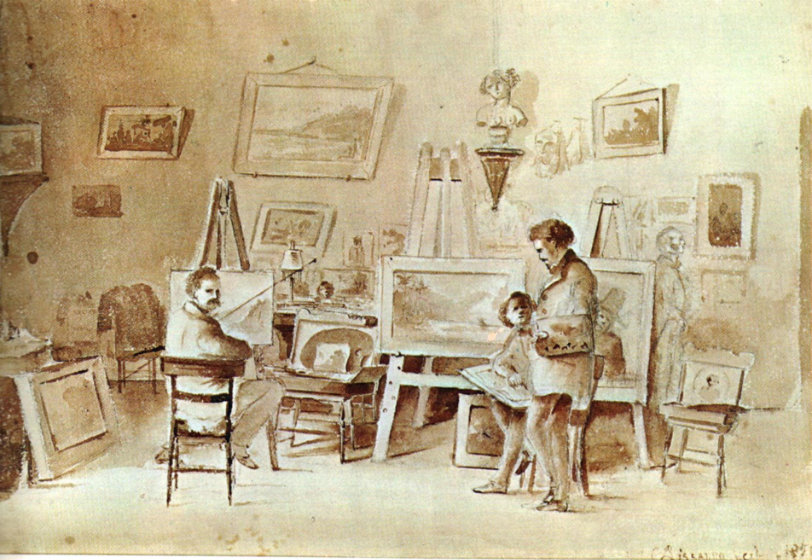
Pissarro and Fritz Melbye’s studio in Caracas, Venezuela, about 1854. The History Collection / Alamy Stock Photo
July 10, 1830
Jacob Abraham Camille Pissarro is born in the Danish Caribbean port of Charlotte Amalie, St. Thomas, to Frédéric Pissarro and Rachel Manzana-Pomié, Jewish merchants with French ties.
July 3, 1848
Slavery is abolished in the Danish colonies.
1852–54
Against his family’s wishes, Pissarro travels with Danish painter Fritz Melbye to Venezuela, staying in the port of La Guaira for a few months. They then settle in Caracas, setting up their own studio.
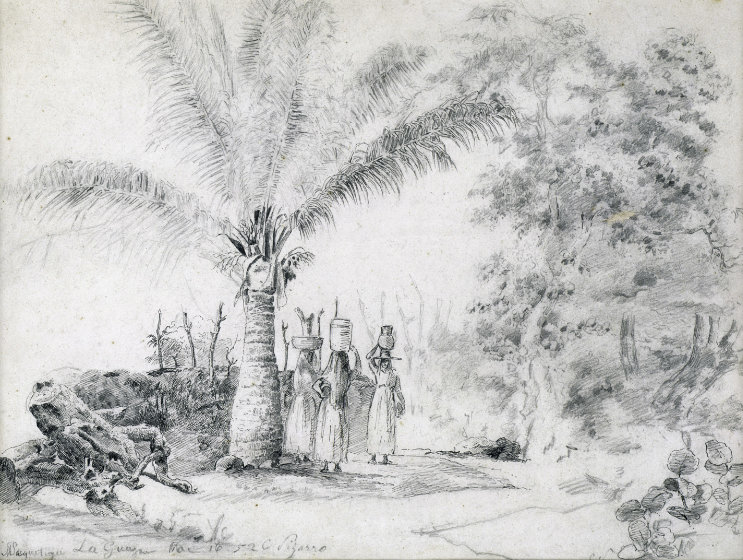
La Guaira
1852
Graphite pencil and ink on paper
Colección Patricia Phelps de Cisneros
Camille Pissarro, Public domain, via Wikimedia Commons
When Pissarro and Melbye arrived in Venezuela, they established a studio in the port city of La Guaira. This sketch was most likely made soon after their arrival. Here, Pissarro uses pencil and ink to depict local inhabitants carrying jugs beneath a lush, tropical tree. The diagonal hatching in this work—particularly in the tree stump on the left—is one of the most identifiable characteristics of Pissarro’s early years as a graphic artist.
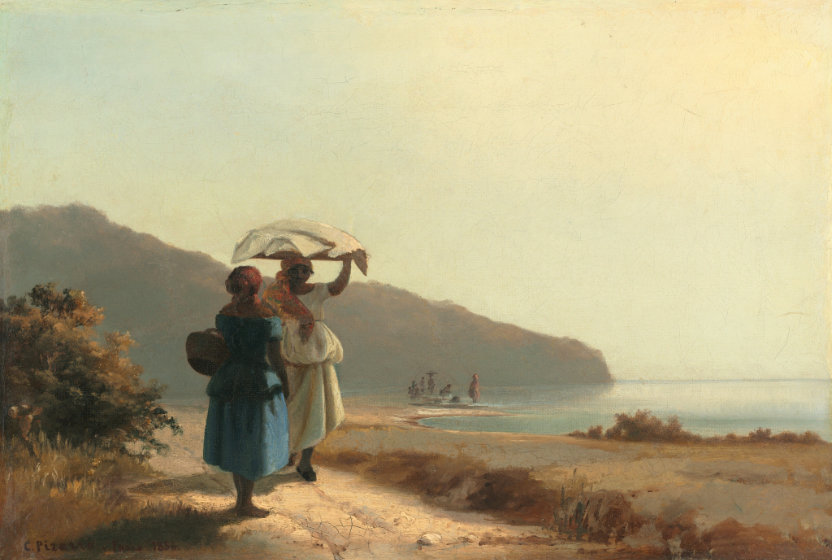
Two Women Chatting by the Sea, Saint Thomas
1856
Oil paint on canvas
National Gallery of Art, Washington, DC: Collection of Mr. and Mrs. Paul Mellon, 1985.64.30
102: Two Women Chatting by the Sea, St. Thomas, 1856 (with Natalia Vieyra)
NARRATOR: Two Afro-Caribbean women meet on a path for a chat—the woman in white carrying freshly laundered linens may be done with her work, while the one in blue could be on her way to join the others washing garments in the sea. This is a scene of St. Thomas, the Danish-controlled Carribbean island of Camille Pissarro’s birth. Now part of the U.S. Virgin Islands, it was a diverse, international trading hub, initially built by chattel slavery and sugar plantations. On the island, there were many domestic enslaved persons—especially washerwomen—that labored for wealthier households, including Pissarro’s family before the abolition of slavery in 1848. Afterwards, it still remained a common occupation.
NATALIA VIEYRA: He made many images of washerwomen in St. Thomas. This subject of labor is a theme that he would return to again and again throughout his career, and it's really solidified here as one of the primary preoccupations of his work. I'm Natalia Vieyra, and I am the associate Curator of Latinx Art at the National Gallery of Art in Washington, DC.
NARRATOR: St. Thomas happened to be home to one of the most complex and populous Jewish communities in the Americas. Pissarro came from a family of successful merchants who traded and sold dry goods in the island's capital of Charlotte Amalie. They hoped he would help run the family business, but Pissarro wanted to be an artist, and eventually he was able to leave for Paris.
NATALIA VIEYRA: Something I think really important to understand about these early oil paintings that Pissarro did was that he painted them in Paris over 4,000 miles away...these scenes aren't painted from life. They're not painted en plein air, which would come to be one of the defining aspects of Impressionism. They're painted from his memory, and also from hundreds of sketches that he made during his youth, and he brought them with him when he embarked upon his artistic life in France. He really sought to initially market himself as a Caribbean painter and he even included his birthplace of Saint Thomas on his business cards.
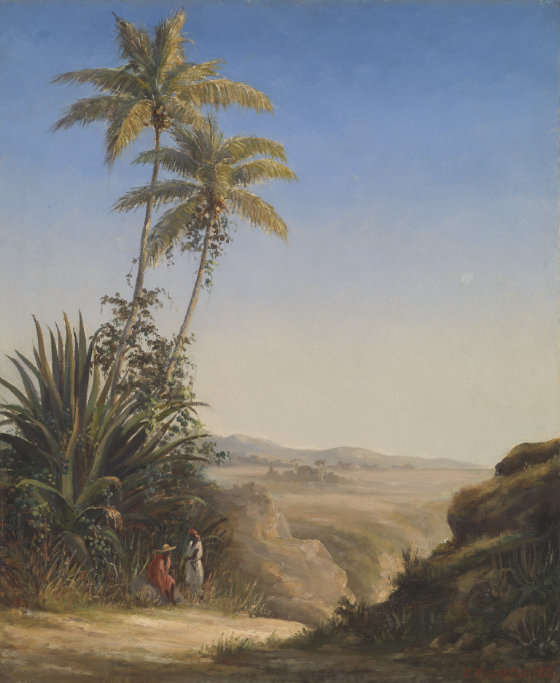
Landscape, Saint Thomas
1856
Oil paint on canvas
Virginia Museum of Fine Arts, Richmond: Collection of Mr. and Mrs. Paul Mellon, 83.46
Photo by Sydney Collins, courtesy Virginia Museum of Fine Arts
In 1855, Pissarro moved to Paris to pursue his career as an artist. At first, he continued to paint Caribbean and South American subjects. Although this scene depicting the encounter of two Afro-Caribbean women on a seaside path outside of Charlotte Amalie could have been sketched on site, Pissarro likely combined observation, memory, and fiction.
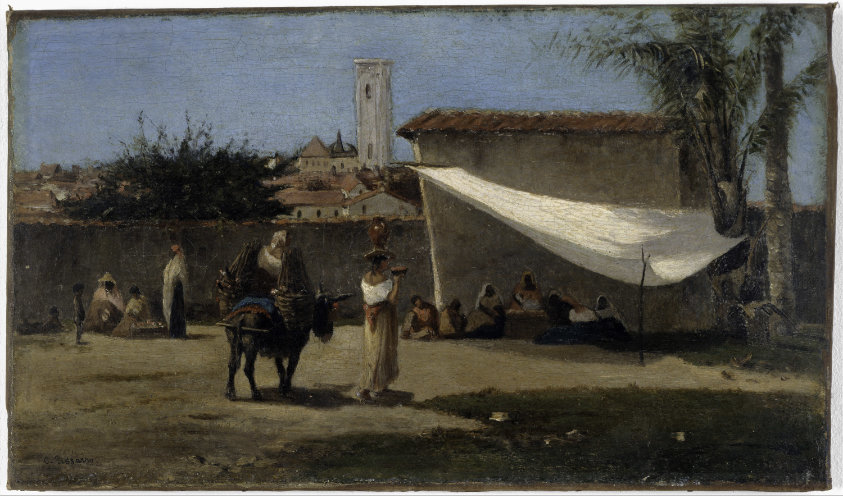
A Plaza in Caracas
About 1854
Oil paint on canvas
Colección Patricia Phelps de Cisneros
Photo courtesy Carlos Germán Rojas
The Altagracia church serves as a backdrop for the marketplace of Caracas, where a female figure strolls along the market square with a jug balancing on her head. To her right, a group of figures lounges in the shade of an open tent. These compositional elements recall Orientalist tropes depicting local inhabitants trapped in a fictional past, a colonialist pictorial tradition well established in France at the time of Pissarro’s arrival in the mid-1850s.

Exhibition Guide Sections
- Introduction
- Artistic Beginnings: St. Thomas and Venezuela
- Path to Impressionism
- A Life in Letters
- Portrait of a Family
- The Impressionist Journey
- Rural Communities: Harvest and Market Scenes
- Pissarro's Fans
- At Home in Éragny
- A Garden Retreat
- Against the Grain: Politics and Neo-Impressionism
- Normandy Harbors
- Sights of Paris
- Audio Guide


The Honest Eye: Camille Pissarro's Impressionism is co-organized by the Denver Art Museum and the Museum Barberini, Potsdam.
It is presented by Jana and Fred Bartlit, Barbara Bridges, Bridget and John Grier, the Kristin and Charles Lohmiller Exhibitions Fund, and Craig Ponzio.
The exhibition is also supported by the Tom Taplin Jr. and Ted Taplin Endowment, Adolph Coors Exhibition Endowment Fund, Birnbaum Social Discourse Project, Lori and Grady Durham, Kathie and Keith Finger, Sally Cooper Murray, Ellen and Morris Susman, Lisë Gander and Andy Main, Mary Pat and Richard McCormick, Kent Thiry and Denise O'Leary, Robert Lehman Foundation, Christie's, the donors to the Annual Fund Leadership Campaign, and the residents who support the Scientific and Cultural Facilities District (SCFD). This exhibition is supported by an indemnity from the Federal Council on the Arts and the Humanities. Promotional support is provided by CBS Colorado.
