
In the late 1880s, art dealer Paul Durand-Ruel struggled to sell artworks by Pissarro and other impressionists. One challenge was that Pissarro was changing his style, despite the risk of putting off his previous admirers. He was enthused by the younger painters Georges Seurat and Paul Signac, and in 1885, began adopting their pointillist technique. The neo-impressionist style of applying color in small dots was based on the newest developments in color theory. Pissarro used short dashes rather than dots, but he abandoned the time-consuming experiment in 1890, believing he was losing touch with spontaneity.
Despite this creative break, Pissarro maintained his anarchist political ties with the more radical Neo-Impressionists. His sensitivity to social injustice never wavered, and he deeply mistrusted the French government, the church, and the army. He subscribed to two anarchist publications and occasionally contributed, yet rarely made explicitly political artworks, preferring to express his desires for social harmony through his landscapes.
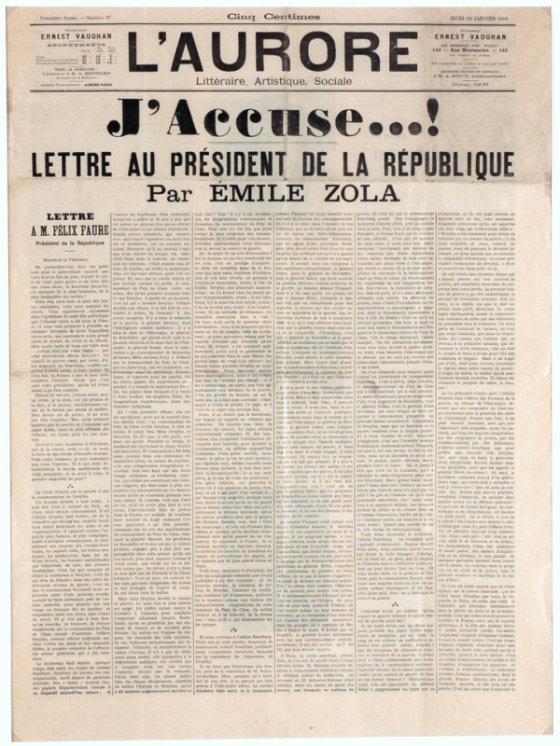
Title page of the daily newspaper L'Aurore with Émile Zola’s historic open letter (I Accuse…!) Photo © mahJ / Christophe Fouin, courtesy musée d’art et d’histoire du Judaïsme
1885
Through Paul Durand-Ruel, Pissarro meets Octave Mirbeau, who will become an important critic of the artist’s career in the 1890s. Pissarro also meets Paul Signac and Georges Seurat and finds renewed energy exploring the neo-impressionist style.
1886
The eighth and final impressionist exhibition takes place. The group falls apart as the artists explore different stylistic directions. Pissarro eventually convinces the group that Neo-Impressionists should be included but exhibited in a separate room.
1893
In response to anarchist efforts following a café bombing the year before, the French government begins to pass laws restricting the freedom of the press. A mass of sweeps, searches, arrests, and prison sentences ensues. Pissarro continues to take precautions with his own anarchist sympathies.
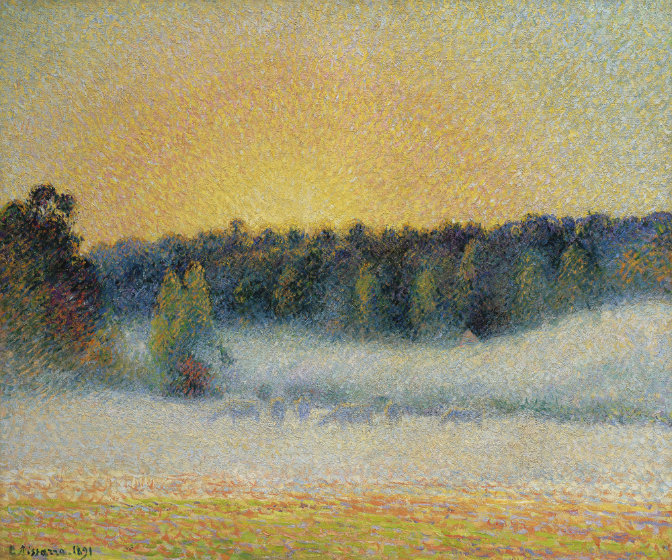
Meadow at Éragny with Cows, Fog, Sunset
1891
Oil paint on canvas
Private collection, Switzerland
Here, details of the landscape dissolve into a unified atmosphere and luminous bands of color. This pursuit of unity and harmony extends from the canvas to Pissarro’s beliefs about the aims of society. According to fellow anarchist Octave Mirbeau, Pissarro believed that “the painter is ‘in humanity,’ in the same way as the poet, the farmer . . . the chemist, the worker . . . For him, the painter contributes, along with all those who do something useful and beautiful, to the work of general harmony.”
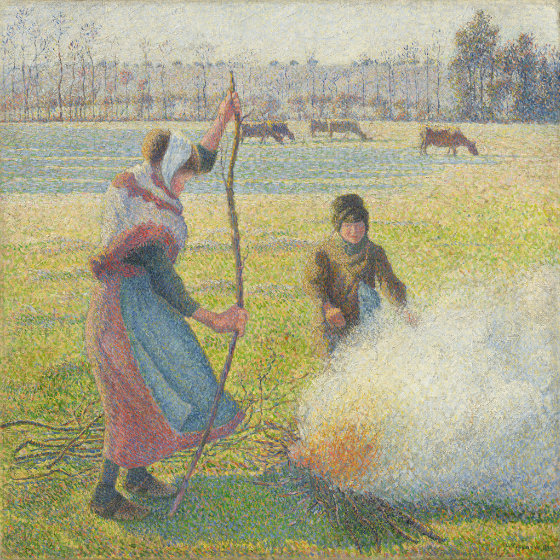
Hoarfrost, Peasant Girl Making a Fire
1888
Oil paint on canvas
Hasso Plattner Collection, Museum Barberini, Potsdam, MB-Pis-02
Image courtesy akg-images/Laurent Lecat
By the late 1880s, Pissarro was experimenting with a neo-impressionist technique of short brushstrokes in pure hues in the pursuit of greater luminosity. Here, he depicts a young woman who has kindled a fire in a field on a windy winter day. The contrasts work together in harmony: light and shadow, dampness and dryness, and the tension between the steadiness of the branch the woman holds and the unconstrained flickering of the fire.
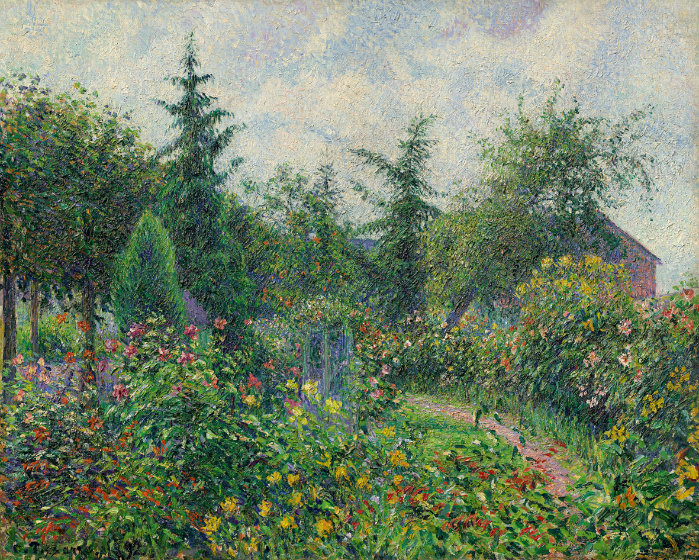
The Garden and Henhouse at Octave Mirbeau’s, Les Damps
1892
Oil paint on canvas
Hasso Plattner Collection, Museum Barberini, Potsdam, MB-Pis-03
111: Vegetable Garden, Overcast Morning, Éragny, 1901
NARRATOR: In September 1892 Camille Pissarro spent two weeks at the country home of writer and critic Octave Mirbeau, completing four large-scale views of his friend’s garden. A wild rhythm of dots and dashes build up the colorful floral splendor in a neo-impressionist style that Pissarro had been experimenting with at the time. He struggled with continuing in this new, time-consuming approach, writing:
CAMILLE PISSARRO: “What to do to have the purity and simplicity of dots as well as the full-bodied, supple, free, spontaneous, and fresh feel of our impressionist art? That’s what’s preoccupying me a great deal.”
NARRATOR: Octave Mirbeau shared Pissarro’s anarchist political views, but it was quite a u-turn for Mirbeau, who had been a former nationalist, known for writings with antisemitic undertones. Although Pissarro rarely discussed it in his letters, he knew that French society at the time was not entirely welcoming to Jews. The 1890s in particular saw a violent rise of anti-Semitism in France, and some of his friendships would become fractured.
Although Pissarro had abandoned any form of religious practice, he described himself and thought of himself as Jewish. He was alone amongst his artist circle in that regard, but not for long—the early decades of the 20th century would see Jewish émigré artists flock to Paris and play important roles in the development of modern art.
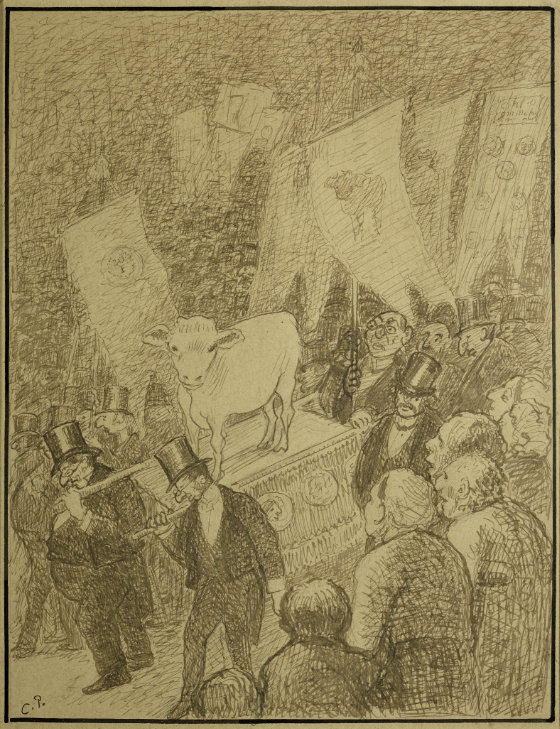
The New Idolators
1889
Ink on paper
Denver Art Museum: The T. Edward and Tullah Hanley memorial gift to the people of Denver and the area, 1974.395
Pissarro rarely made explicitly political works for public view. Originally planned to be included in his collection of drawings Turpitudes Sociales (Social Disgraces), a book for his nieces, this sketch depicts a parade of capitalists carrying banners and a golden calf, transforming the biblical story into one about the worship of money.
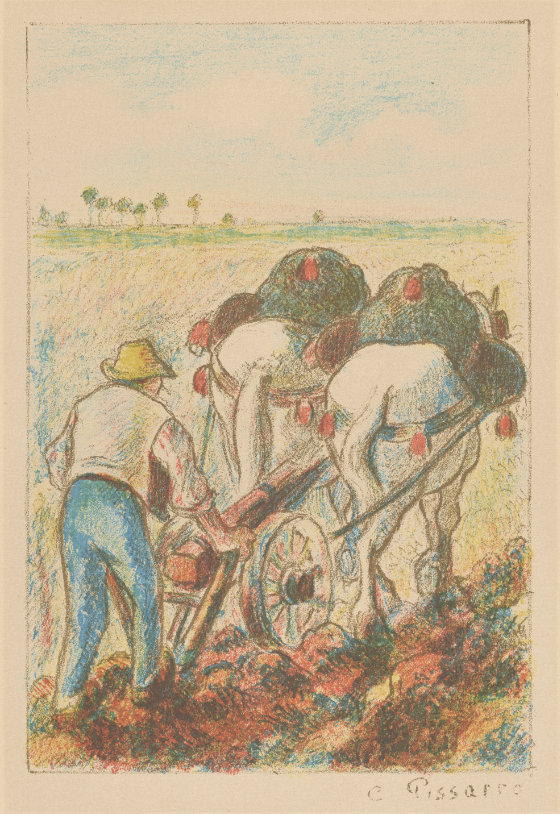
The Plow
1901
Lithograph on paper
Denver Art Museum: Gift of Noëlle and George Beatty, 2024.705
Plowing, which prepares for sowing, is both destructive and productive—an analogy embraced by many anarchists who aimed to achieve social transformation. Pissarro made this lithograph as a frontispiece for the literary supplements in the third volume of the anarchist journal Les Temps Nouveaux in 1901.
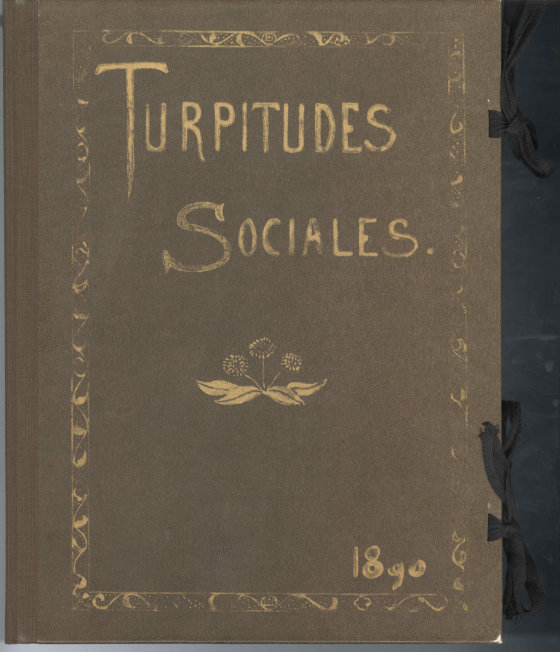
Turpitudes Sociales (Social Disgraces)
After 1889–90
Ink on paper
Private collection, Courtesy of Pissarro & Associates Fine Art
Courtesy Pissarro Family Archives
These 28 satirical drawings were bound in a book for the political education of Pissarro’s nieces Esther and Alice Isaacson. In pages such as The Temple of the Golden Calf and The Asphysia (studies are on view above), the artist chastises capitalistic excess. Each page depicts problems facing society, including starvation, poverty, domestic violence, and exploitation. It closes with a scene of violent insurrection by the urban working class.

Exhibition Guide Sections
- Introduction
- Artistic Beginnings: St. Thomas and Venezuela
- Path to Impressionism
- A Life in Letters
- Portrait of a Family
- The Impressionist Journey
- Rural Communities: Harvest and Market Scenes
- Pissarro's Fans
- At Home in Éragny
- A Garden Retreat
- Against the Grain: Politics and Neo-Impressionism
- Normandy Harbors
- Sights of Paris
- Audio Guide


The Honest Eye: Camille Pissarro's Impressionism is co-organized by the Denver Art Museum and the Museum Barberini, Potsdam.
It is presented by Jana and Fred Bartlit, Barbara Bridges, Bridget and John Grier, the Kristin and Charles Lohmiller Exhibitions Fund, and Craig Ponzio.
The exhibition is also supported by the Tom Taplin Jr. and Ted Taplin Endowment, Adolph Coors Exhibition Endowment Fund, Birnbaum Social Discourse Project, Lori and Grady Durham, Kathie and Keith Finger, Sally Cooper Murray, Ellen and Morris Susman, Lisë Gander and Andy Main, Mary Pat and Richard McCormick, Kent Thiry and Denise O'Leary, Robert Lehman Foundation, Christie's, the donors to the Annual Fund Leadership Campaign, and the residents who support the Scientific and Cultural Facilities District (SCFD). This exhibition is supported by an indemnity from the Federal Council on the Arts and the Humanities. Promotional support is provided by CBS Colorado.
